


When forming an LLC, two key documents are involved: Articles of Organization and an Operating Agreement. Here’s the difference:
- Articles of Organization: This is your LLC’s legal foundation. It’s filed with the state to officially create your business. It includes details like your LLC name, address, and registered agent. This document is required in all states and becomes public record.
- Operating Agreement: This private document outlines how your LLC will operate internally. It covers ownership, profit-sharing, decision-making, and dispute resolution. It’s only legally required in five states (California, Delaware, Maine, Missouri, New York) but is highly recommended everywhere.
Quick Overview:
- Articles of Organization: Mandatory, public, legal registration.
- Operating Agreement: Optional (except in 5 states), private, internal rules.
Both documents protect your LLC’s limited liability status and ensure smooth operations. Without them, you risk personal liability and potential disputes.
What Are Articles of Organization?
Definition and Purpose
Articles of Organization are the legal documents you file with your state – usually through the Secretary of State’s office – to officially establish your LLC. These documents are what make your LLC a recognized legal entity, granting it its own rights, powers, and responsibilities.
The filing process typically requires you to provide key details such as your business name (including "LLC" or "Limited Liability Company"), your principal office address, registered agent information, a statement outlining your business purpose, and whether your LLC will be member-managed or manager-managed.
"Articles of organization are essential for forming an LLC and establishing its rights, powers, and duties." – Investopedia
Once filed, your LLC gains its legal foundation. Next, let’s walk through the filing process.
How to File Articles of Organization
Most states provide standardized forms online to simplify the filing process. Before submitting, ensure your business name is unique and complies with state requirements.
Filing fees vary by state, ranging from $35 to $500, with the average cost hovering around $100. Some of the least expensive states include Kentucky ($40), Montana ($35 for online filing), and Colorado ($50). On the higher end, states like Massachusetts ($500), Tennessee (minimum $300), and Texas ($300) charge more. Processing times are generally about a week, but online filing often speeds things up.
If you’re forming an LLC in Arizona, Nebraska, or New York, you’ll need to publish a notice in a local newspaper, which adds time and cost.
Public Record Status
Once approved, your Articles of Organization become part of the public record. This means that details like your business address and registered agent information are accessible through state databases. If privacy is a concern, you might want to use a professional registered agent service to list a commercial address instead of your home address.
It’s worth noting that not all states call this document "Articles of Organization." For example, Delaware, Texas, and a few others use the term "Certificate of Formation," while states like Connecticut and Pennsylvania call it a "Certificate of Organization". Regardless of the name, the purpose of the document remains the same.
sbb-itb-ba0a4be
What Is an Operating Agreement?
Definition and Purpose
An Operating Agreement is a private, legally binding document that outlines how your LLC functions on a daily basis. While the Articles of Organization establish your LLC as a legal entity, the Operating Agreement governs its internal workings. This includes defining member roles, responsibilities, financial decisions, and the overall management structure.
"An operating agreement is the governing contract adopted by members of a Limited Liability Company (LLC). It lays out the business’s course and helps operations and management become more organized." – Wex Definitions Team, Cornell Law School
One of its key roles is to protect the limited liability status of the LLC by clearly distinguishing business assets from personal ones. Unlike Articles of Organization, which are public, the Operating Agreement remains a private document. It allows you to tailor the rules and operations of your LLC rather than relying on default state laws, which may not always align with your business goals.
What Goes in an Operating Agreement
A well-crafted Operating Agreement typically includes:
- Ownership Details: Specifies each member’s ownership percentage and initial contributions, whether in cash, property, or services.
- Profit and Loss Allocation: Explains how profits and losses will be divided among members.
- Management Structure: Defines whether the LLC is member-managed or manager-managed.
- Voting Rights and Decision-Making: Outlines voting procedures and thresholds for decision-making.
- Transfer and Exit Provisions: Covers rules for transferring membership interests or buying out members.
- Deadlock and Dispute Resolution: Provides methods for resolving disagreements among members.
- Dissolution Procedures: Details how the business will be closed and assets distributed if the LLC is dissolved.
Is an Operating Agreement Required?
Only five states – California, Delaware, Maine, Missouri, and New York – legally require LLCs to have an Operating Agreement. However, even in states where it’s not mandatory, having one is highly beneficial. Without it, your LLC will default to state laws, which may not suit your specific needs. For single-member LLCs, an Operating Agreement is especially important to document the separation between personal and business matters, reinforcing liability protection.
"The purpose of the document is to govern the internal operations of the business in a way that suits the specific needs of the business owners." – Ijeoma S. Nwatu, U.S. Small Business Administration
Operating Agreements are private and not filed with the state. They should be stored securely with other key business documents. For the best results, consult both an attorney and an accountant when drafting your agreement to ensure it meets legal and financial requirements, including compliance with IRS rules for profit and loss allocation.
Articles of Organization vs. Operating Agreement: Main Differences
Purpose and Legal Requirements
The Articles of Organization are the cornerstone of your LLC’s legal foundation. Filing this document with your state officially establishes your business as a recognized entity. It’s a non-negotiable step for forming an LLC, no matter where you operate in the U.S.
On the flip side, the Operating Agreement is all about how your LLC functions day-to-day. It lays out the rules for member roles, profit sharing, voting processes, and overall management. While only five states require this document by law, having one is a smart move for any LLC. It ensures clarity and structure in your business operations, tailored to your specific needs.
Now, let’s dive into how these documents differ in terms of accessibility and how they can be updated.
Public vs. Private Documents
One major difference between these documents is how accessible they are. Articles of Organization are public records. Once filed with the Secretary of State, anyone can request access to basic details like your LLC’s name, registered agent, and business address.
"Articles of organization become part of the public record once they’re filed. At this point, the articles of organization are available to anyone upon request." – LegalTemplates
In contrast, the Operating Agreement is private. It’s only shared among members, managers, and key stakeholders, keeping your internal business dealings confidential.
Amending these documents also follows different processes. Changes to the Articles of Organization require filing a Certificate of Amendment with the state and paying any applicable fees. Meanwhile, the Operating Agreement can be updated internally with member approval, without needing to notify the state.
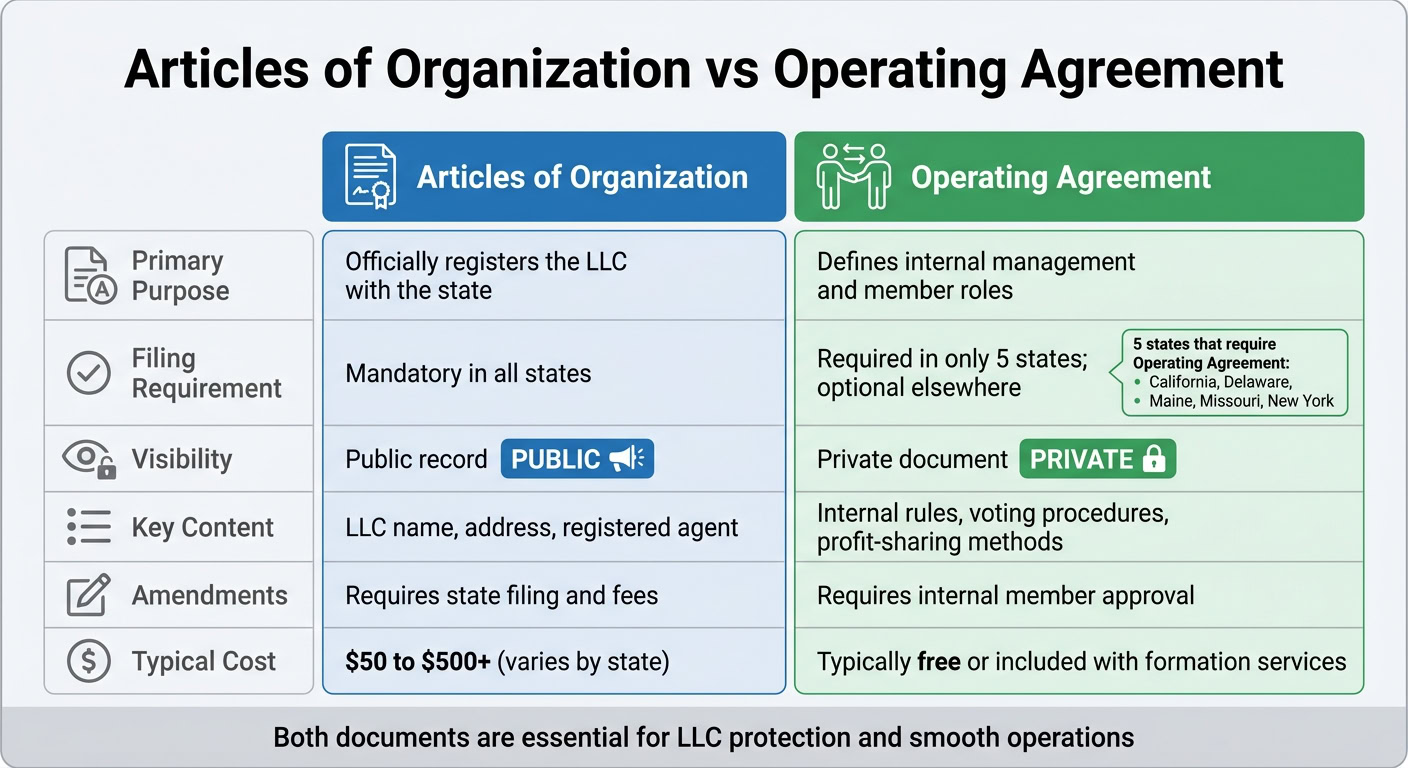
To make these distinctions even clearer, here’s a side-by-side comparison.
Side-by-Side Comparison
Here’s a quick look at how the Articles of Organization and Operating Agreement stack up:
| Feature | Articles of Organization | Operating Agreement |
|---|---|---|
| Primary Purpose | Officially registers the LLC with the state | Defines internal management and member roles |
| Filing Requirement | Mandatory in all states | Required in only 5 states; optional elsewhere |
| Visibility | Public record | Private document |
| Key Content | LLC name, address, registered agent | Internal rules, voting procedures, profit-sharing methods |
| Amendments | Requires state filing and fees | Requires internal member approval |
| Typical Cost | $50 to $500+ (varies by state) | Typically free or included with formation services |
It’s a good idea to keep your Articles of Organization handy – banks and lenders often need a copy to set up business accounts or provide credit cards. As for your Operating Agreement, store it securely with your other sensitive business documents to keep everything organized and private.
When to Use Each Document
When to File Articles of Organization
You should file Articles of Organization when you’re ready to officially form your LLC. This step is essential to legally establish your business and protect your personal assets from liability risks. Think of this filing as your LLC’s official charter – it creates a legal distinction between your personal and business finances. To get started, gather details like your LLC’s name, address, registered agent, and member information. Then, head to your state’s Secretary of State website to complete the process.
Keep in mind, filing fees can vary significantly. For instance, New York charges $200, but fees in other states can range from $50 to over $500. Once your filing is approved, your next step is to obtain an EIN (Employer Identification Number) from the IRS. This number is essential for opening a business bank account and handling taxes. With your LLC legally formed, you can shift your focus to organizing internal operations.
When to Create an Operating Agreement
While the Articles of Organization provide your LLC with legal standing, the Operating Agreement establishes how your business will run on a day-to-day basis. Ideally, you should draft this document immediately after filing your Articles of Organization, even if your state doesn’t require it. Only five states – California, Delaware, Maine, Missouri, and New York – mandate an Operating Agreement. In New York specifically, you have 90 days from filing your Articles of Organization to complete this step.
This agreement is crucial because it outlines key details such as member roles, voting rights, and how profits will be divided. Without it, your LLC will default to state rules that may not align with your business goals. For example, some states require profits to be split equally among members, regardless of their individual investments. An Operating Agreement ensures your business operates according to your specific needs, not generic state guidelines.
Risks of Missing Either Document
Both the Articles of Organization and the Operating Agreement are essential for the health and legality of your LLC. Skipping the Articles of Organization means your business isn’t officially recognized, leaving your personal assets exposed to liability risks.
As Ijeoma S. Nwatu, Digital Strategy Consultant at the U.S. Small Business Administration, explains:
"Operating agreements give members protection from personal liability to the LLC. Without this specific formality, your LLC can closely resemble a sole proprietorship or partnership, jeopardizing your personal liability."
Meanwhile, not having an Operating Agreement can lead to internal disputes that might spiral into expensive legal conflicts. A well-crafted agreement helps set clear expectations and resolves potential issues before they escalate. Both documents work together to ensure your LLC operates smoothly and is shielded from unnecessary risks.
Conclusion
The Articles of Organization and the Operating Agreement are two key pillars of any LLC. They serve different but complementary purposes: the Articles of Organization legally establish your LLC, while the Operating Agreement outlines how it will operate internally. Without the Articles, your LLC has no legal existence. Without an Operating Agreement, your business is subject to default state laws that might not align with your preferences.
These documents are more than just legal formalities – they’re practical tools for running your business. Banks typically require the Articles of Organization to open a business account, and investors often want to review the Operating Agreement to understand your management structure. Together, they also help preserve the "corporate veil", shielding your personal assets from business liabilities.
Even for single-member LLCs in states where an Operating Agreement isn’t mandatory, having one is crucial. It helps establish a clear boundary between personal and business assets, which is vital in disputes with creditors or legal challenges. Always keep updated copies of both documents with your registered agent, accountant, and attorney. Together, they ensure your LLC is legally sound and operationally organized, giving you a solid foundation to navigate the competitive world of business.
FAQs
Do I need an Operating Agreement for a single-member LLC?
Yes, most states don’t legally mandate it, but having an operating agreement for a single-member LLC is strongly advised. It serves as a key document to clarify ownership, safeguard your personal liability protection, and outline how your business will be managed. These factors are essential for maintaining compliance and proving that your LLC is a distinct legal entity.
What happens if my LLC has no Operating Agreement?
If your LLC doesn’t have an operating agreement, state default rules will dictate how it operates. The problem? These rules might not match the specific arrangements or expectations you and your members have in mind. This can lead to confusion or even disputes down the road. By creating an operating agreement, you establish clear guidelines that align with your business goals and prevent unnecessary misunderstandings.
When do I need to amend my Articles of Organization?
When your LLC undergoes major changes, it’s essential to amend your Articles of Organization. Typical reasons for doing this include updating your business address, replacing your registered agent, or altering the management structure. These updates help ensure your business stays compliant with state laws and that your records remain up to date.