


A statutory agent (also called a registered agent, resident agent, or agent for service of process, depending on the state) is a person or entity responsible for receiving legal documents, government correspondence, and compliance-related paperwork on behalf of a business. Every U.S. business entity, such as LLCs and corporations, is legally required to designate a statutory agent to ensure they don’t miss crucial legal notices or state communications.
Here’s what you need to know:
- Purpose: They act as the official contact between the business and the state or court system.
- Responsibilities: Receive legal documents (like lawsuits), tax notices, and compliance reminders, and forward them promptly to the business.
- Requirements: Must have a physical address in the state of registration, be available during business hours, and meet state-specific qualifications.
- State Differences: Terminology, filing rules, and agent requirements vary. For example, California requires an "agent for service of process", while in New York, the Secretary of State serves as the default agent for LLCs.
- Consequences of Non-Compliance: Missing deadlines or not maintaining an agent can lead to legal penalties, default judgments, or even administrative dissolution of the business.
Whether you act as your own agent or hire a professional service (typically costing $99–$300/year), maintaining a reliable statutory agent is critical to staying legally compliant and avoiding costly issues.
Key Responsibilities of a Statutory Agent
Receiving Legal and Compliance Documents
The main job of a statutory agent is to handle the service of process – this includes receiving formal legal documents like lawsuits, subpoenas, summons, and complaints. These documents often kick off a strict 20- to 30-day window for legal responses. Once a process server delivers the paperwork, they notify the court, creating an official record that the business has been informed.
In addition to legal documents, statutory agents also receive important government mail. This can include annual report reminders, franchise tax notices, and compliance updates from the Secretary of State. After receiving these documents, the agent must act quickly to ensure they are forwarded to the correct party.
Forwarding Official Correspondence
Once legal notices are in hand, the statutory agent’s next step is to forward them without delay. Failing to relay time-sensitive documents can result in serious consequences, such as default judgments if deadlines are missed. Quick forwarding is critical to avoid such issues.
"A Statutory Agent is a person or company who receives legal documents and notices from the state for an LLC. Said another way, a Statutory Agent is a receiver and forwarder of documents." – Matt Horwitz, Founder & Educator, LLC University®
Many professional agents streamline this process with digital tools. They offer services like same-day scanning, email alerts, and secure online storage, which allow businesses 24/7 access to their documents. Compared to traditional mail, digital forwarding minimizes delays and reduces the risk of losing important paperwork.
Staying Available During Business Hours
Being available during business hours is essential for a statutory agent to fulfill their role effectively. Most states require the agent to be physically present at a registered street address (not a P.O. box or virtual mailbox) from Monday to Friday, 9:00 AM to 5:00 PM. Business owners who act as their own agents may face challenges if they are not consistently present at their registered address. Missing a delivery could lead to significant legal issues, like default judgments.
Professional statutory agent services eliminate this risk by ensuring an in-person presence during the required hours, helping businesses maintain their good legal standing.
| Responsibility | What It Involves | Why It Matters |
|---|---|---|
| Service of Process | Accepting lawsuits, subpoenas, and legal complaints | Starts the legal response clock; missed notices can lead to default judgments. |
| Government Correspondence | Receiving tax notices, annual report reminders, etc. | Ensures the business stays compliant and in good standing. |
| Document Forwarding | Quickly delivering received documents to the business | Prevents missed deadlines and potential legal penalties. |
| Physical Availability | Being present at a registered address during business hours | Guarantees reliable receipt of legal documents. |
sbb-itb-ba0a4be
Who Can Serve as a Statutory Agent?
Eligibility Requirements for Individuals and Entities
To serve as a statutory agent, specific qualifications must be met. For individuals, they need to be at least 18 years old and reside in the state where the business is registered. Business entities, such as professional registered agent companies, can also take on this role, provided they are authorized to operate in that state and maintain a physical office there.
However, state-specific rules often add more complexity. For example, in California, an LLC or corporation cannot act as its own agent for service of process. In Colorado, agents must hold a valid state-issued ID, while Virginia limits the role to members of the State Bar or company management. These variations emphasize the importance of understanding local requirements when appointing or serving as a statutory agent.
"A registered agent is your business’s official point of contact for receiving legal documents, government notices, and compliance materials." – Rick Mak, Founder, BusinessAnywhere
In most states, the agent must also provide written consent to accept the appointment. Wyoming, for instance, requires agents to sign a formal "Consent to Appointment" form. Along with meeting these qualifications, agents must adhere to specific address and availability rules.
Address and Availability Requirements
Statutory agents must also satisfy strict address and availability criteria. They are required to maintain a physical street address in the state where the business is registered – P.O. boxes and virtual mailboxes are not acceptable, as legal documents must be delivered in person.
Moreover, agents must be available during standard business hours, typically Monday through Friday, 9:00 AM to 5:00 PM. Neglecting this obligation can lead to severe consequences. For instance, in Andover Senior Care, LLC v. Called To Care Invs. Kan. LLC, a federal bankruptcy court upheld a $785,000 default judgment because the registered office was unstaffed during business hours.
For businesses operating across multiple states, a separate agent with a physical presence is required in each state. This requirement is one reason many business owners opt for professional registered agent services, which generally cost between $99 and $300 annually per state.
It’s also worth noting that a statutory agent’s name and address are public records, accessible through the Secretary of State’s website. Business owners who act as their own agent risk exposing their personal address to the public, making careful selection crucial for balancing privacy and compliance.
How Statutory Agent Rules Differ by State
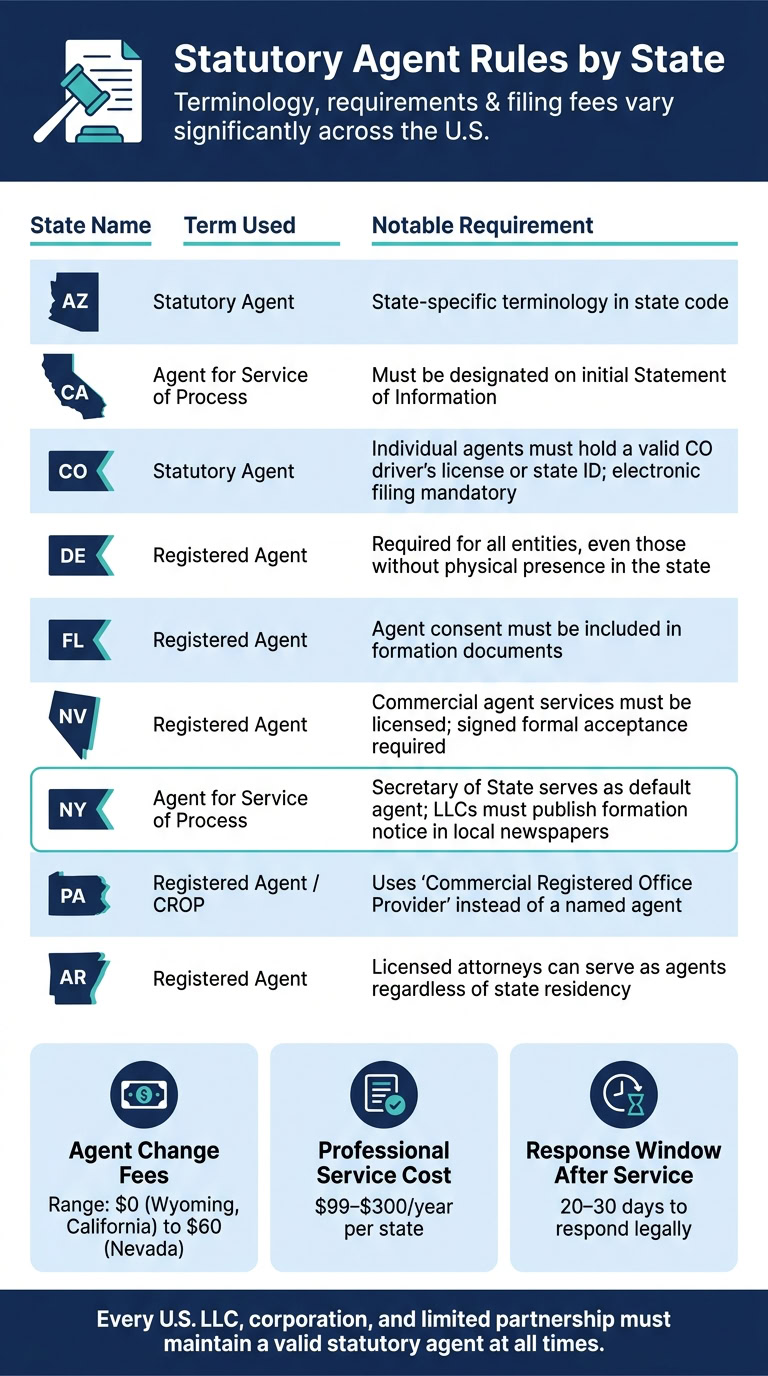
Common Differences Across States
Local regulations play a big role in shaping the statutory agent’s responsibilities, ensuring businesses meet the specific legal expectations of each state.
One of the first hurdles for new business owners is understanding the terminology. While the function remains consistent, the title varies – Registered Agent, Statutory Agent, Resident Agent, or Agent for Service of Process.
"The terminology can be confusing – but the function is the same. Every state requires an official contact person or company authorized to receive legal and government correspondence." – SingleFile
Beyond the name, states differ significantly in rules about consent, eligibility, and filing. For instance:
- Florida requires agent consent to be included in formation documents.
- Nevada mandates licensing for commercial agent services and a signed formal acceptance from the initial agents.
- Colorado specifies that agents must have a valid Colorado driver’s license or state ID.
- Arkansas allows licensed attorneys to serve as agents, even if they live outside the state.
Some states take a unique approach. In New York, the Secretary of State automatically serves as the agent for service of process. Pennsylvania, on the other hand, uses the term "Commercial Registered Office Provider" (CROP) instead of requiring a named individual agent.
State-by-State Comparison Table
Here’s a quick overview of key differences across states:
| State | Term Used | Notable Requirement |
|---|---|---|
| Arizona | Statutory Agent | Terminology specific to the state code |
| California | [Agent for Service of Process | Must be designated on the initial Statement of Information](https://businessanywhere.io/registered-agent-california/) |
| Colorado | Statutory Agent | Individual agents must have a valid Colorado driver’s license or state ID; electronic filing is mandatory |
| Delaware | Registered Agent | Required for all entities, even those without a physical presence in the state |
| Florida | Registered Agent | Agent consent must be included in formation documents |
| Nevada | Registered Agent | Commercial agent services must be licensed; signed formal acceptance is required |
| New York | Agent for Service of Process | Secretary of State serves as the default agent; LLCs must publish a formation notice in local newspapers |
| Pennsylvania | Registered Agent / CROP | Uses "Commercial Registered Office Provider" (CROP) instead of a named agent |
| Arkansas | Registered Agent | Licensed attorneys can serve as agents, regardless of state residency |
Changing a statutory agent usually involves a filing fee, which ranges from $5 to $50 in most states, though some charge as much as $100. If your business operates in multiple states, each state treats it as a "foreign" entity, requiring its own local agent. Opting for the best registered agent service with offices nationwide can simplify compliance and reduce the need to manage separate agents in each jurisdiction.
These state-specific nuances underscore the importance of understanding local rules when appointing or changing a statutory agent. Each state’s approach can impact how businesses handle compliance.
How to Appoint or Change a Statutory Agent
Appointing a Statutory Agent During Business Formation
When forming your business, you’ll need to designate a statutory agent. This agent’s name and physical address must be included in your formation documents – either the Articles of Organization for an LLC or the Articles of Incorporation for a corporation. Be careful: errors or omissions in this section can result in your filing being rejected.
To meet the requirements, your agent must have a physical address in the state where your business is registered, be at least 18 years old (if an individual), and be available during regular business hours. These rules ensure the agent can fulfill their primary role: receiving legal documents and being accessible when needed.
In many states, the agent must formally consent to the role before filing. For instance, Arizona requires a separate "Statutory Agent Acceptance Form" for paper filings, while in Colorado, a simple checkbox on the formation paperwork suffices.
"The registered agent’s name and physical address become part of the public record when you file your Articles of Incorporation or Articles of Organization." – Rick Mak, Founder, BusinessAnywhere
This is an important consideration if you’re thinking of acting as your own agent. Using your home address means it will become part of the public record. To avoid this, many business owners opt for professional registered agent services, which typically cost between $100 and $300 annually per state. For example, BusinessAnywhere offers such services starting at $147 per year, with the first year free if bundled with a new business registration.
Once your business is up and running, changing your statutory agent is a straightforward process.
Changing a Statutory Agent After Formation
If you need to update your statutory agent after your business is established, most states have a simple process. Typically, you’ll file a standalone form, such as a "Statement of Change of Registered Agent" or "Certificate of Change", directly with the Secretary of State. In some states, like Florida and Wyoming, you can even make this update for free during your annual report filing.
The fees for stand-alone agent changes vary by state, ranging from $0 to $70. Here’s a quick comparison:
| State | Standalone Change Fee | Notes |
|---|---|---|
| Arizona | $5 | Online filing available |
| Texas | $15 | Requires agent consent; file via SOSDirect |
| Florida | $25 ($0 with annual report) | Free if updated during annual report |
| Delaware | $50 | Online via ICIS system |
| Nevada | $60 | One of the highest fees in the U.S. |
| Wyoming | $0 | Included in annual report |
| California | $0 | Included in Statement of Information |
It’s crucial to maintain continuous agent coverage. Don’t cancel your current agent’s service until the new agent is officially on record. A lapse in coverage can lead to serious issues:
"If your entity is sued and there is no registered agent to receive the summons, the plaintiff can serve your entity in another way that may not result in your entity responding to the summons in time… A default judgment can be entered against your entity even if the lawsuit was frivolous." – Colorado Secretary of State
If your agent resigns, you typically have 30 to 60 days to appoint a replacement to avoid administrative dissolution. The resigning agent must file a formal Statement of Resignation, which usually takes effect 30 to 31 days after filing. This gives you a brief window to secure a new agent and file the necessary paperwork.
Why Keeping a Statutory Agent Matters
Staying in Good Legal Standing
In the U.S., every business is required to have a statutory agent to serve as its official contact with the state. This role is crucial for maintaining good standing, which is essential for opening bank accounts, securing loans, entering into contracts, and expanding into other states through foreign qualification.
A dependable statutory agent does more than just receive legal documents – they help keep your business on track. Many professional agents monitor state filing deadlines and send reminders for annual reports or franchise tax obligations, ensuring you don’t miss critical dates. This is especially important when lawsuits arise, as businesses typically have only 20 to 30 days to respond after being served. Quick notification can mean the difference between mounting a strong defense or facing a default judgment.
Failing to meet this requirement can lead to serious consequences.
Penalties for Not Having a Statutory Agent
The importance of timely document receipt cannot be overstated. Here’s what can happen if your business lacks a statutory agent:
| Risk Category | Immediate Consequence | Long-Term Impact |
|---|---|---|
| Litigation | Missed summons or complaint | Default judgment and financial liability |
| Compliance | Late fees and penalties | Administrative dissolution of the entity |
| Operations | Loss of good standing | Inability to bank, borrow, or sign contracts |
| Legal Rights | Inability to sue others | Unenforceable business contracts |
| Asset Protection | A delinquent status | Loss of liability protection |
One of the most severe outcomes is administrative dissolution. If the state dissolves your business, it ceases to legally exist. This means your business name could be taken by someone else, and you lose the personal liability protection you once had. Reinstating a dissolved business can be both time-consuming and expensive. Fees for reinstatement usually range from $25 to $200, not including back taxes, interest, and penalties.
"Courts have consistently held that a breakdown in communication between the registered agent and the business does not excuse the failure. The company is responsible for its agent’s performance." – LegalClarity Team
Conclusion
A statutory agent isn’t just a formality – it’s a legal requirement for every LLC, corporation, and limited partnership in the United States. From the day your business is formed until it’s dissolved, you need someone dependable with a physical street address in your state, available during regular business hours.
While the role might seem simple, it’s absolutely crucial. Your statutory agent is responsible for receiving lawsuits, tax notices, and other government documents on your behalf. Missing even one of these can lead to serious consequences, like a default judgment, losing your good standing, or even administrative dissolution – sometimes without you realizing it until it’s too late.
Each state has its own rules for terminology and requirements, but the bottom line is the same: you must always have a valid and reachable agent. If your agent steps down, most states give you just 30 to 60 days to find a replacement before taking action.
"If your Registered Agent misses Service of Process or fails to forward important notices from the state, you’re still responsible for the instructions or obligations that were in the documents." – Matt Horwitz, Founder & Educator, LLC University
Whether you choose to act as your own agent, appoint someone you trust, or hire a professional service, the choice has real implications. Professional services typically charge between $99 and $300 per year – a small price compared to what even one missed legal notice could cost your business. That fee isn’t just about convenience; it’s about safeguarding the foundation of your business.
FAQs
Can I be my own statutory agent?
Yes, you can serve as your own statutory agent if you meet your state’s specific requirements. These typically include being a resident of the state where your business is registered, having a physical street address (not a P.O. box) in that state, and being available during regular business hours to accept legal and government documents. However, it’s important to note that your name and address will become part of the public record, and you won’t have the privacy or dependability that professional services can provide.
What happens if my statutory agent can’t be reached?
If your statutory agent becomes unavailable or you fail to keep one, your business could miss out on important legal notices – like lawsuits or tax deadlines. This oversight can result in serious outcomes, including default judgments, state-imposed fines, losing your good standing, or even administrative dissolution, which would terminate your business’s legal status. Keeping your agent reachable is crucial to staying compliant and safeguarding your business.
Do I need a statutory agent in every state I register in?
Yes, most states mandate having a statutory agent – commonly known as a registered agent or agent for service of process – in every state where your business operates. This applies to both your home state and any states where your business is foreign qualified.
One notable exception is New York, where the Secretary of State acts as the default agent for LLCs. It’s important to note that agents must have a physical address (not a P.O. box) and be available during standard business hours.