

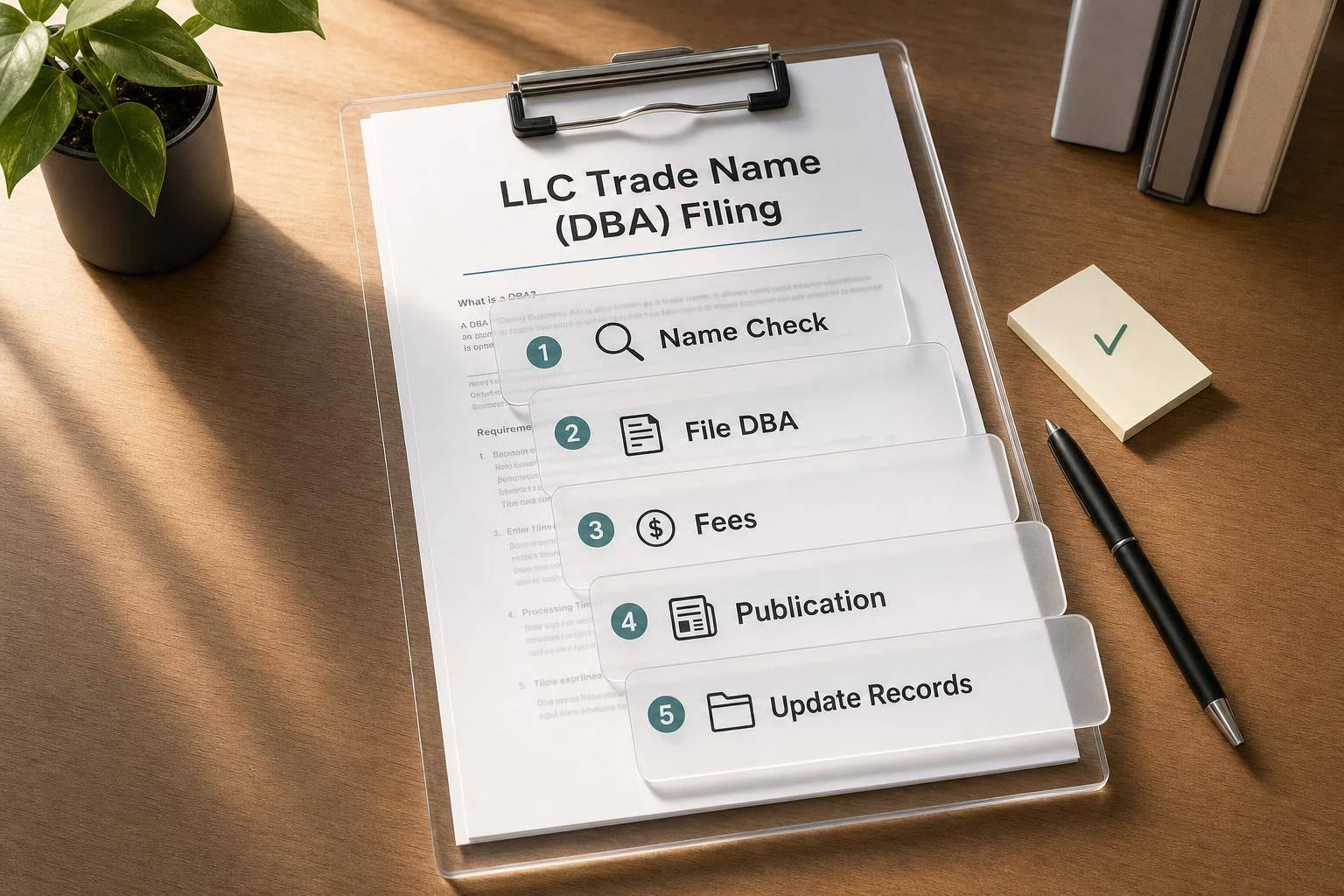
You can add a DBA to your LLC without forming a new company. Your LLC keeps the same EIN, taxes, owners, and liability setup. The DBA is just the name the public sees.
Here’s the short version:
- A DBA is a trade name, not a new business entity.
- Your LLC stays the legal party on contracts, taxes, and bank records.
- You must check name availability first at the state, county, domain, and USPTO levels.
- Filing rules change by state, and in some places by county or city.
- Fees often run from about $20 to $150+, and publication can add $30 to $200.
- Some DBAs expire in as little as 1 year or 2 years, while others last 5 years, 10 years, or have no set end date.
- After approval, you still need to update banking, licenses, tax records, and contracts.
If I were doing this myself, I’d think about it this way: a DBA helps me sell under a new name, but it does not give me a new LLC, new legal protection, or ownership of the brand. That last part matters because a state DBA filing does not give trademark rights.
A few points stand out:
- If I sign a contract using only the DBA, I can make it less clear that the LLC is the party to the deal.
- If my state has a publication rule and I skip it, the filing can be canceled.
- If I miss a renewal date, I can run into bank or compliance problems.
- If the new brand has different owners or more legal risk, I’d look at forming a new LLC instead of using a DBA.
In plain English: filing a DBA means pick a name, clear it, file it in the right place, pay the fee, finish any publication step, and keep it active.
That’s the whole job this guide covers.
What a DBA does for an LLC
What ‘doing business as’ means for an LLC
A DBA is a registered alias that lets your LLC operate under a different public name for marketing, sales, and payments. The LLC is still the legal entity behind that name.
One LLC can have more than one DBA. That can help if you want to run separate brands or product lines while keeping the same legal structure. In places where there’s no statewide filing system, each assumed name must be filed on its own in every county or municipality where you plan to use it.
A DBA gives you a public-facing business name. It does not give you ownership rights to that name.
Put simply, a DBA is a branding tool, not a change to the business itself.
What a DBA does not change
A DBA does not change your LLC’s EIN, tax status, ownership, management, or operating agreement.
It also does not create a new liability shield. Any income, debt, or legal risk tied to a DBA still belongs to the same LLC. That’s why contracts and official records should use the legal LLC name in this format: "[Legal LLC Name], d/b/a [DBA Name]." If you sign with only the DBA, it can muddy the waters and make it less clear that the LLC, not you as an individual, is the party to the contract.
That point matters more than many owners think. A DBA may change how the business looks to the public, but behind the scenes, the same LLC is still on the hook.
When a DBA makes sense and when a new LLC may be better
A DBA often makes sense when you want to shorten a long legal name, roll out a new product line, or try a new market without paying to form another entity.
A new LLC is usually the better path if the new venture has major liability risk, different owners, or needs its own tax return and EIN. A DBA can’t do any of that.
sbb-itb-ba0a4be
Check name availability and filing requirements before you apply
Check the name before you file. A rejected DBA can slow your launch. Since a DBA does not change the LLC itself, your first job is to make sure the name can be filed and used legally. Once you have the right name and the right office, the rest of the process gets much smoother.
Confirm the DBA name is allowed and not too similar
Filing offices often reject DBA names that are too close to names already on file, even if the difference is just a small spelling tweak. And if the name includes words linked to regulated fields, you may need special approval before you can use it in a DBA.
You also should not use an entity ending that points to a different business type. If your business is an LLC, don’t file a DBA that ends in Inc. or Corp..
Search state, county, domain, and trademark records
A proper name check has a few parts. Start with your state’s business name database to see whether the name is already in use by an LLC, corporation, or registered trade name. If your state requires county-level filing – about 19 states do, including California, Texas, New York, and Illinois – check the county clerk or superior court records in every county where you plan to do business.
Then look online. Search domain availability and major social media handles. A business that already uses the name online can still create a problem, even if it does not have a federal trademark.
After that, search the U.S. Patent and Trademark Office database at uspto.gov. State or county DBA approval does not give you trademark rights, and it will not shield you from a federal infringement lawsuit.
Save screenshots or notes from each search. It’s a small step, but it can save you a headache later.
Once the name clears those checks, confirm the exact office and form rules.
Verify your LLC is active and find the correct filing office
Many jurisdictions want your LLC to be in good standing before they will take a DBA application. That usually means your annual reports are up to date and you have met all annual requirements by state. Some offices also ask for a Certificate of Good Standing with the filing. Check your LLC status on your Secretary of State’s website before you apply.
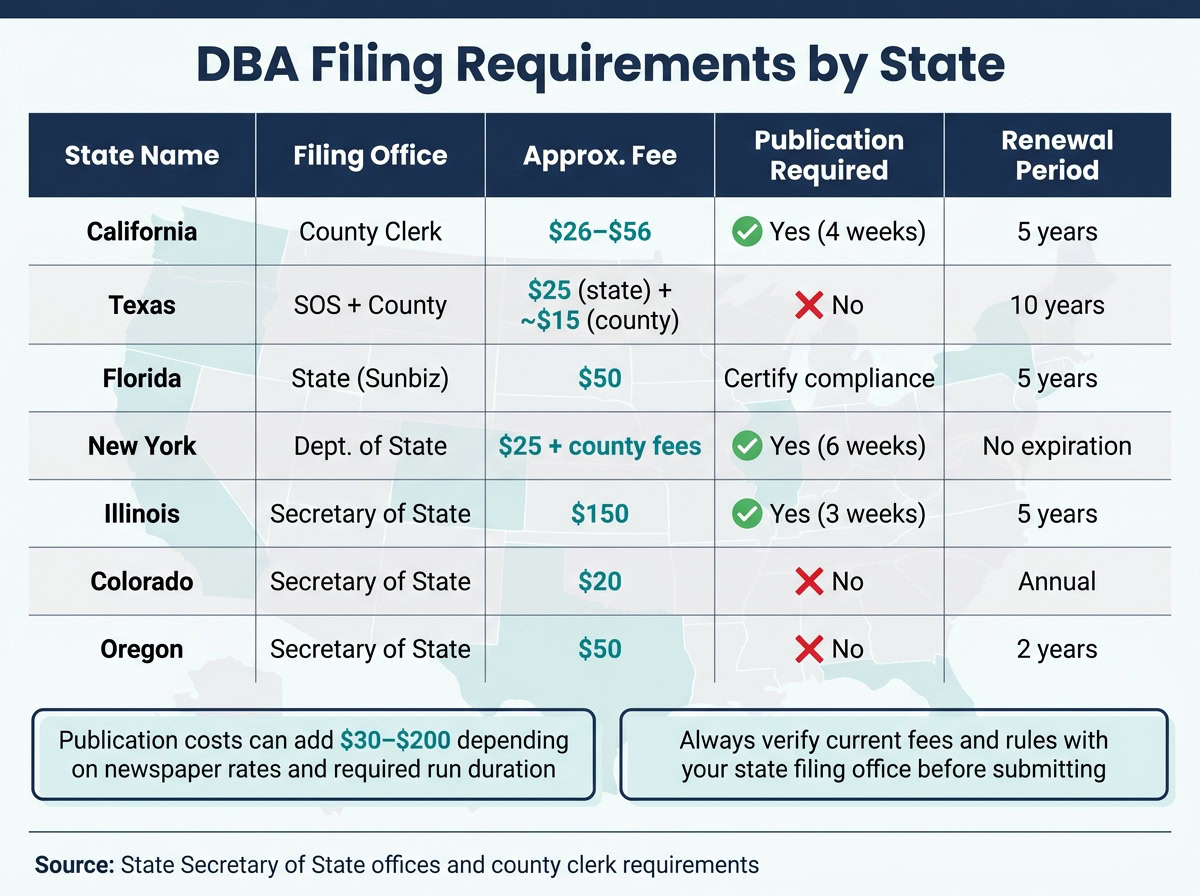
The right filing office depends on where you are. Some states handle DBA filings at the state level, some at the county level, and some at the city or town level. The filing office, fee, publication rule, and renewal period can change a lot from one state to the next. The examples below show common filing patterns, approximate fees, and renewal rules.
| State | Filing Office | Approx. Fee | Publication Required | Renewal |
|---|---|---|---|---|
| California | County Clerk | $26–$56 | Yes (4 weeks) | 5 years |
| Texas | SOS + County | $25 (state) + ~$15 (county) | No | 10 years |
| Florida | State (Sunbiz) | $50 | Certify compliance | 5 years |
| New York | Dept. of State | $25 + county fees | Yes (6 weeks) | No expiration |
| Illinois | Secretary of State | $150 | Yes (3 weeks) | 5 years |
| Colorado | Secretary of State | $20 | No | Annual |
| Oregon | Secretary of State | $50 | No | 2 years |
Double-check the office before you file. If you send the form to the wrong place, the filing can be void. After that, you’re ready to gather the details the form asks for.
How to file a DBA for your LLC, step by step
Gather the information required on the DBA form
Once the name passes the filing rules, fill out the form exactly the way the office wants it.
Most DBA forms ask for the same basic details:
- Your LLC’s exact legal name as shown on its formation papers
- The state where the LLC was formed
- A physical street address for service of process
- The DBA name you want to use
- A short description of the business purpose
- The date you plan to start using the name
If the form asks for member or manager names, list the person who has authority to sign for the LLC. That signature is made under penalty of perjury, so it has to come from an authorized member or manager. Some offices also require notarization, so check the signature instructions before you file.
Enter the legal LLC name first, then the DBA. For example: "Jane Jones Enterprises LLC, d/b/a J.J.’s Computer Services".
Once the form is filled out, you’re ready to send it in using the office’s accepted filing method.
Submit the filing, pay the fee, and track processing
You can usually file online, by mail, or in person, depending on the office. Online filings are often processed in 1–5 business days. Mail filings often take 2–4 weeks.
Pay the listed fee, keep your receipt, and save the approved copy for your bank.
Meet publication, renewal, amendment, and cancellation rules
Getting approval isn’t always the last step.
Some states require you to publish a notice of the DBA in a local newspaper after filing. Skip that step, and the registration can be voided in full. Publication usually costs $30 to $200, based on the newspaper’s rates and the number of weeks the notice has to run.
Rules for publication and renewal change from state to state, so read the filing office instructions closely and put every deadline on your calendar.
After publication, get the publisher’s affidavit. This is the signed proof-of-publication document from the newspaper. Then file it with the proper government office. Nebraska, for example, requires that proof within 45 days of the initial filing.
Set a reminder 60 days before the DBA expires. If you miss a renewal, the DBA record can be suspended and cause bank or enforcement issues. If your LLC’s name or address changes, file articles of amendment. If you stop using the DBA, file an abandonment or cancellation.
How to use the DBA correctly after approval
How to write the LLC name and DBA together in contracts and invoices
Once the DBA is approved, use it the same way everywhere the business appears in public. At this stage, the job is no longer about filing. It’s about making sure the name shows up correctly in day-to-day business. The DBA is the brand people see. The LLC is still the legal party.
On contracts and invoices, name the party as: "[Legal LLC Name] LLC, d/b/a [Trade Name]." If you use only the DBA, it can muddy who is legally bound. The person signing should also use their LLC title, such as Member or Manager.
On Form W-9, put the LLC’s legal name on Line 1 and the DBA on Line 2.
Update licenses, tax accounts, banking, and payment processors
After you fix contracts, make sure banking and tax records match that same naming setup.
The LLC’s EIN does not change. Banks often want a DBA certificate or fictitious name registration before they will open an account or take checks made out to the trade name. So when you open or update an account, bring the certificate, the LLC’s EIN, and the formation documents.
It’s also smart to update:
- Bank records
- Licenses and permits
- Insurance
- Vendor records
- Payment processors
That helps you avoid billing problems or coverage gaps. Report the trade name to the IRS with Form 8822-B or on the next return.
LLC-to-DBA examples and recordkeeping basics
One LLC can register more than one DBA under the same EIN.
Keep one folder for the DBA paperwork, including the DBA certificate, publication proof, filing receipt, and renewal notices. Store those records with the LLC’s operating agreement and annual compliance files. Add a calendar reminder for renewal dates at least 60 days before expiration.
Store the filing, track renewals, and keep the DBA tied to the LLC’s compliance records.
Conclusion: Add a brand name while keeping the LLC in good standing
A DBA lets your LLC use a brand name without changing the legal business entity behind it. Once you understand that split, the process is pretty simple.
Here’s the basic path: clear the name, file with the right office, pay the fee, handle publication if your state requires it, and update your records after approval.
After approval, the main task is keeping the registration active. DBA filings often need renewal, and if one expires, it can disrupt banking and your right to use the name.
That’s the big distinction: a DBA helps with branding, while a trademark protects ownership. If you want nationwide brand protection, file a federal trademark with the USPTO after the DBA is in place.
File it the right way, keep it current, and your LLC can do business under a clean brand name without losing good standing.
FAQs
Can my LLC have more than one DBA?
Yes. A single LLC can register and operate under more than one DBA.
This is common when a company wants to use different brand names, product lines, or storefront names while keeping everything under one legal entity.
There’s one catch: each DBA usually needs its own registration based on your state or county rules.
Even with multiple DBAs, they all still sit under the same LLC. That means they share the same tax ID and the same liability profile.
Do I need a new EIN for a DBA?
No. A DBA is just another name for your current business, not a separate legal entity.
Your LLC still uses its original EIN for taxes and for work done under the DBA, including banking, contracts, and tax filings.
When should I form a new LLC instead?
Form a new LLC instead of filing a DBA when you need a separate legal entity for liability protection or tax reasons.
Here’s the plain-English version: a DBA is just a trade name. It doesn’t create a new business entity. A new LLC, on the other hand, gives you a separate legal structure.
A new LLC makes more sense when you want to:
- isolate liability for a project or line of business
- separate ownership or member interests
- keep finances and tax filings fully separate
If the goal is just to operate under another name, a DBA may do the job. But if you need legal and financial separation, a new LLC is usually the better move.