

If my LLC was administratively dissolved, I can often get it back by fixing the missed filings, paying what I owe, and filing for reinstatement with the state.
That’s the short answer.
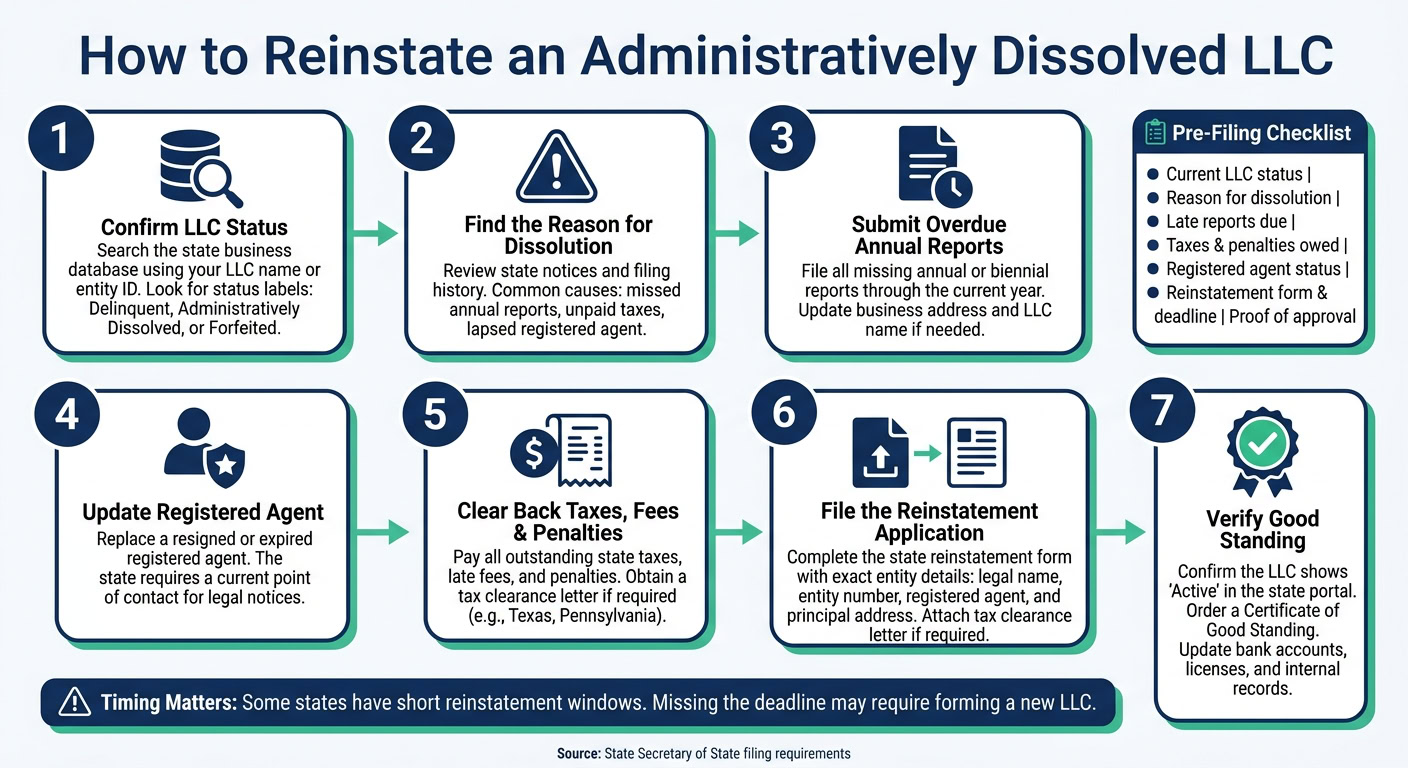
In most cases, the path looks like this:
- I check the LLC’s status in the state business database.
- I find the exact reason for the dissolution.
- I file any late annual or biennial reports.
- I fix the registered agent if needed.
- I pay back taxes, fees, and penalties.
- I submit the reinstatement filing and keep proof.
- I confirm the LLC shows Active again and get a Certificate of Good Standing.
This process is often fixable, but timing matters. Some states give a short filing window. And state fees can add up fast once late reports, tax balances, and penalties stack together.
Here’s the main point: I can’t reinstate the LLC until every state-level problem tied to the dissolution is cleared. That may include a tax clearance letter in some states, plus updated business records if the address or registered agent changed.
Before I start, I make a simple checklist:
- Current LLC status
- Reason for dissolution
- Late reports due
- Taxes, fees, and penalties owed
- Registered agent status
- State reinstatement form and deadline
- Proof of approval after filing
If I move through those items in order, the reinstatement process is usually much smoother.
Reinstatement and dissolution are separate filings. Once the LLC is back in good standing, read our guide on how to dissolve an LLC to close it properly.
Step 1: Confirm the LLC’s Status and Identify the Reason for Dissolution
Check the State Business Database and Recent Compliance Notices
Start with your state’s Secretary of State website. Search for your LLC using its legal name or entity ID number, then open the filing history to see what triggered the dissolution.
Next, check the Status field. If your LLC is still active, you’ll usually see labels like Active, Good Standing, or In Existence. If the state has dissolved it, the record may show one of these:
| Status Label | What It Means |
|---|---|
| Delinquent | Annual report is overdue; usually the first warning stage before dissolution |
| Administratively Dissolved | The state has terminated the LLC’s legal authority due to non-compliance |
| Forfeited | Typically tied to unpaid franchise taxes or missing tax filings |
Those labels matter because each one points to a different filing or tax issue. Take a screenshot for your records and for account recovery if you need it later.
You should also review any notices the state mailed or emailed. These usually go to the registered agent or the business address on file. If either one was out of date, the notices may have slipped past you before the dissolution happened.
Once you’ve pinned down both the status and the trigger, write out every filing, payment, and registration issue that needs to be cleared before reinstatement.
Identify Every Item Blocking Reinstatement
Before you file anything, make a full list of what still needs to be fixed. This step can save you time because one missing item can stall the whole process.
The two issues that most often block reinstatement and add extra steps are:
- Tax clearance letters – States like Texas and Pennsylvania require a clearance letter from the state taxing authority before the Secretary of State will process the reinstatement.
- Reinstatement deadline – Check the deadline before paying any fees. If you miss the window, you may need to form a new LLC instead.
After you’ve identified every blocker, clear those issues before you send in the reinstatement application.
sbb-itb-ba0a4be
Step 2: Fix the Compliance Problems Before Filing Reinstatement
Before you file for reinstatement, clear the issues you found in Step 1. This is the cleanup phase: submit missing filings, fix the registered agent, and pay any amount due.
File Overdue Annual Reports and Update the Registered Agent
File each missed annual or biennial report through the current year. While you’re doing that, update the LLC’s address and state records so everything matches the current business details.
If the registered agent resigned or the appointment expired, replace that agent before you file. The state needs a current point of contact for legal papers and future notices. And if the LLC name is no longer available, submit the required name change or amendment first.
Once the filings and contact details are up to date, move on to taxes, fees, and penalties.
Pay Back Fees, Penalties, and Any State Tax Balance
Pay any state tax balance and work with the state taxing authority to clear what is owed. In some states, you’ll also need to file for a tax-clearance certificate before reinstatement can move forward.
In many states, tax clearance is the last gate before you can file.
Reinstatement also doesn’t wipe out federal filing duties. If the LLC was inactive for several years, you may still need to file delinquent federal returns, such as Form 1065 for a partnership LLC or Schedule C for a single-member LLC.
Step 3: File the Reinstatement Application and Track Approval
Once you’ve cleared the compliance problems, it’s time to file the reinstatement form and any overdue reports the state still needs. This is the point where small mistakes can trip you up. A mismatched address, the wrong legal name, or an unpaid fee can still lead to a rejection.
Complete the State Reinstatement Form with the Correct Entity Details
After you’ve taken care of missing filings and paid any balances, submit the reinstatement paperwork. Go to your state’s official filing portal and follow the reinstatement steps for your LLC. The process can vary by state. In Wyoming, for example, filing overdue annual reports may automatically restore the LLC without a separate reinstatement form.
As you fill out the form, make sure every detail matches the state’s records exactly. That usually includes:
- The LLC’s legal name
- The state-issued entity or charter number
- The registered agent’s name and physical address
- The current principal office address
Some states also ask for the exact date of administrative dissolution.
A few states won’t accept the filing until every issue tied to the dissolution has been fixed. If your state asks for a tax clearance letter, attach it before you submit. Texas and Pennsylvania are two examples.
Once the form is done, submit it with all required attachments.
Submit the Filing, Save Proof, and Verify Good Standing After Approval
Online filing is usually the fastest option. After you submit, save the confirmation number, receipt, and stamped copy. Those records matter. If a bank or insurer later asks you to show that the LLC is active again, this is the paperwork you’ll want on hand.
When the state approves the filing, check the business entity search portal again and confirm the LLC now shows as Active. After that, order a Certificate of Good Standing from the Secretary of State. Banks and lenders often ask for this certificate after reinstatement.
Once approval comes through, update your internal records and business accounts so they match the restored status.
After Reinstatement: Resume Operations and Prevent Another Dissolution
Update Banks, Licenses, Contracts, and Internal Records
Once reinstatement is approved, get every account and record back in line with your LLC’s active status. Start with your bank and payment processors. Reach out as soon as the LLC is active again, since they may require proof of reinstatement before they restore access.
After those core accounts are back in place, review anything that came up while the LLC was inactive. If any business licenses or permits were suspended or flagged, get them reinstated. Then check any contracts signed during dissolution and ratify them if your state requires it.
If your business address changed, file IRS Form 8822-B and update any other required federal records.
Set Up Compliance Reminders and Registered Agent Support to Stay in Good Standing
With operations back on track, the next job is making sure this doesn’t happen again. Set reminders well ahead of each deadline for annual reports and franchise taxes. Use two reminders for each deadline so one missed alert doesn’t turn into a bigger problem. If your state allows it, automate recurring fee payments.
Professional registered agent services is one of the most practical safeguards available. A registered agent helps make sure official notices reach you on time.
It also helps to keep one compliance folder with your LLC name, state file number, and filing receipts. That way, when a notice comes in or a deadline gets close, you’re not hunting through old emails or random files.
FAQs
How long do I have to reinstate my LLC?
It depends on the state where your LLC is registered because each state sets its own deadline.
Some states give you two years. Others allow up to five years. And a few use shorter or more flexible timeframes.
If that window runs out, you usually can’t reinstate the LLC. At that point, you may need to form a new one.
Check your current status as soon as you can in your Secretary of State’s business database.
Can I keep the same LLC name after dissolution?
You may still be able to keep your original LLC name if you move fast, but there’s no promise. Once an LLC is administratively dissolved, its name can become open for another business to claim.
If another company registers that name while your LLC is dissolved, you could lose the right to use it. Check your state’s business registry as soon as possible to see if the name is still open before you begin the reinstatement process.
Do I need a tax clearance letter to reinstate?
It depends on your state’s rules. In some states, your LLC can be reinstated once you file any missing reports and pay past-due fees. In others, you’ll also need a tax clearance or account-status certificate from the state tax agency before the Secretary of State will process the reinstatement.
The best move is to check with your state’s filing office or tax agency, since the process differs across the U.S.