
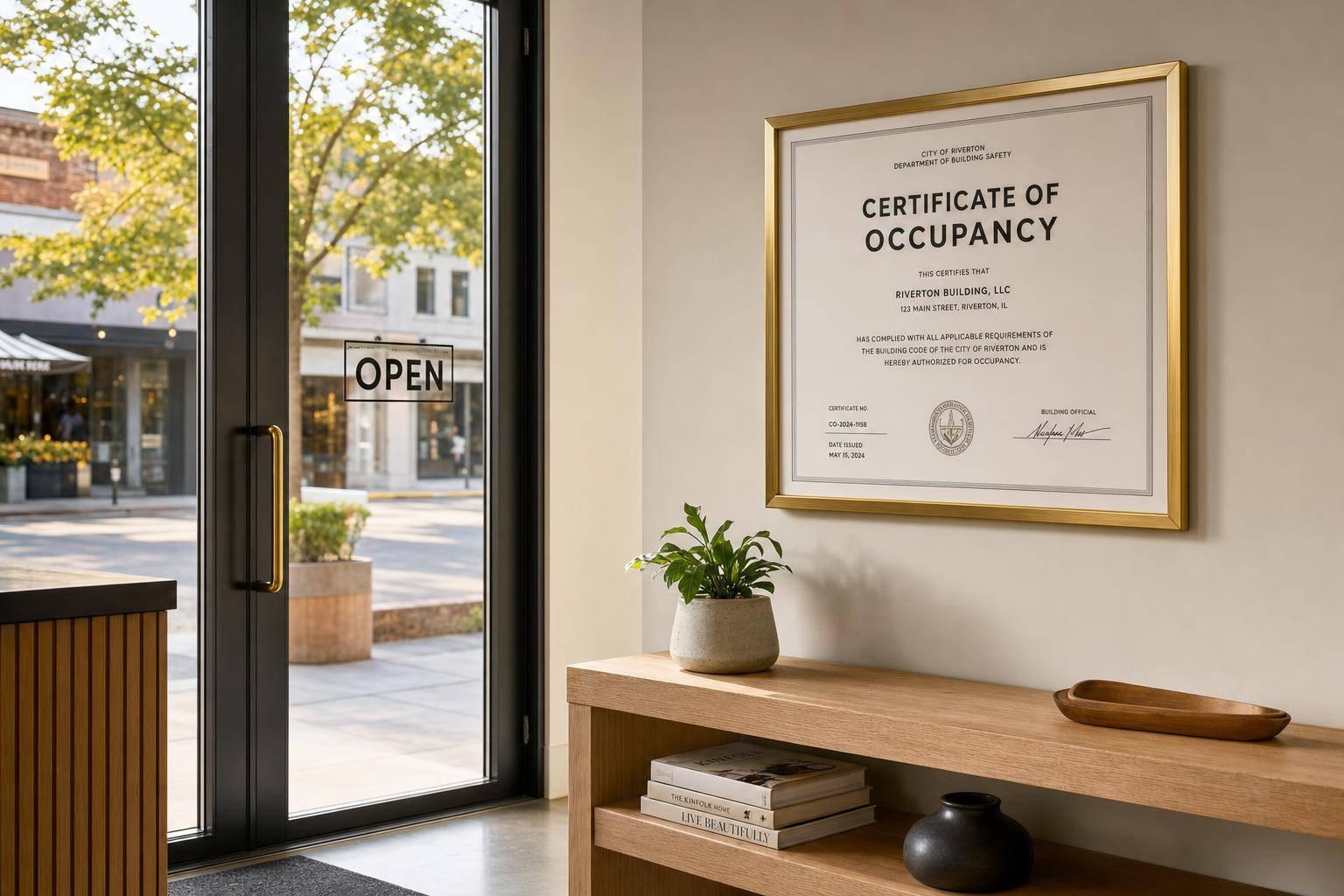
If your space doesn’t have the right CO, you may not be able to open. A Certificate of Occupancy, or CO, is the city or county’s written approval that a space is safe to use and approved for your type of business. If the use on file doesn’t match what you plan to do, you may need a new CO, a revised one, or a temporary one before opening.
Here’s the short version:
- A CO is not the same as a permit or inspection
- New buildings need one before anyone moves in
- A new tenant may or may not need a new CO
- Use changes often trigger a new or updated CO
- Work on exits, fire systems, plumbing, HVAC, or layout can trigger one
- A TCO may let you open for 30 to 90 days while small non-safety items are finished
- Without a valid CO, you can face fines, shutdown orders, lease trouble, and claim denials
I’d treat the CO as a go/no-go item before signing a lease. My first step would be to ask the building department, zoning office, and fire marshal one thing: “Can I legally use this exact space for this exact business?” Then I’d get the answer in writing.
This article breaks down what a CO does, when you need one, how to check, and what can go wrong if you skip it.
What a Certificate of Occupancy is and what it legally confirms
A Certificate of Occupancy, or CO, is an official document issued by your local building or zoning department. It confirms that a specific space is safe to occupy and approved for a defined use. That distinction matters. It doesn’t apply to the building in the abstract. For a business, the issue is whether your office, storefront, or renovated suite matches the use approved for that space.
A CO shows that the space meets rules tied to:
- building code
- zoning
- fire safety
- accessibility
If the space doesn’t meet those rules, the CO is denied. And without a CO, a business can’t legally open. For owners, the big takeaway is simple: your planned use has to match the approval on file.
What information appears on a CO
The exact layout changes by city or county, but most COs include the same basic details:
| Item on a CO | What It Means |
|---|---|
| Property Address | The specific legal location of the building or suite |
| Occupancy Classification | The IBC group code (e.g., Group B for Business, Group M for Mercantile, Group A for Assembly) |
| Approved Use | A plain-language description of the business activity allowed |
| Occupant Load | The maximum number of people legally permitted in the space at one time |
| Fire Protection | Sprinkler system status |
For example, a space classified as Group M (Mercantile) covers retail stores. A Group A (Assembly) classification covers restaurants, bars, and event spaces. Those classifications are not interchangeable. If you run a restaurant in a space with a retail CO, that’s a code violation.
How a CO differs from permits, inspections, and zoning approval
These four terms show up together all the time, and it’s easy to mix them up. But they don’t mean the same thing.
A building permit comes first. It gives you legal permission to start construction or renovation. An inspection comes during or after that work. A code official checks things like electrical wiring, plumbing, and fire suppression to make sure the work meets code.
Zoning approval is separate. It confirms that your type of business is allowed in that location under local land-use rules.
The CO comes last. It is issued only after permits are closed, inspections are passed, and zoning rules are confirmed. This is the document that lets you open your doors to the public.
A simple way to think about it:
- Permits allow the work
- Inspections verify the work
- Zoning approves the use
- CO authorizes occupancy
Each step depends on the one before it. And that match between the space and its approved use is what decides whether you need a new CO.
sbb-itb-ba0a4be
When a business needs a Certificate of Occupancy
Opening or leasing a new commercial space
Now that you know what a CO confirms, the next step is knowing when your business needs one.
Every newly built commercial building needs an initial CO before anyone can legally occupy it. Existing spaces are less straightforward.
If you lease an existing space, whether you need a new CO usually comes down to local rules and whether your use or layout will change. In plain English: does the current approval still match how you plan to use the space?
Philadelphia is a good example. The city does not require a new CO when a new tenant moves in, as long as the business use stays the same. In many other cities, the building department will still check that the space meets code before a new business can open there.
The safest move before signing a lease is simple: call the local building department and ask if your exact situation triggers a new CO requirement.
Changing the use, layout, or life-safety systems of a space
The most common trigger is a change in use. A new or amended CO is usually required when the use, egress, or occupancy type changes.
For example, turning a warehouse into office space can set off a whole new set of rules for ventilation, fire suppression, and plumbing. Same address, very different use.
If your buildout changes exits, fire protection, structure, electrical, plumbing, or HVAC, expect to need an amended CO before opening. Cosmetic updates, like painting or installing new flooring, usually don’t trigger that step.
Temporary or partial occupancy before a space is fully complete
Sometimes a project is almost done, but not fully closed out. In that case, local officials may allow limited occupancy.
A Temporary Certificate of Occupancy (TCO) lets a business open while non-safety punch-list items are still unfinished. But the big safety pieces must already be working. Fire alarms, sprinklers, exits, and emergency lighting all need to be fully operational before a TCO can be issued. Cosmetic items can still be incomplete.
TCOs often expire within 30 to 90 days, although some jurisdictions allow up to six months. On larger projects, a Conditional Certificate of Occupancy (CCO) may allow occupancy in certain fully compliant areas while other parts of the building are still under construction.
| Occupancy Type | Typical Use Case | Key Requirement |
|---|---|---|
| Temporary (TCO) | Non-safety punch-list items remain | Fire alarms, sprinklers, exits, and emergency lighting must be fully functional |
| Conditional (CCO) | One area complete, others still under construction | Clear separation between occupied and work zones |
| Permanent CO | All work finished and inspected | All permits closed, final inspections passed |
Put TCO-to-permanent-CO responsibilities in writing.
How to find out whether your business needs a CO
Whether you need a CO comes down to local approval, not just the condition of the building. So before you sign a lease or open the doors, confirm the rule with the right local offices.
Check with the local building, zoning, and fire authorities
Start with the city building department if the property is inside city limits. If it’s outside city limits, contact county offices instead.
To get a straight answer fast, ask each office one clear question.
| Office | What to Ask |
|---|---|
| Building Department | "Is there a CO on file for [address]? Are there any open permits or unresolved violations?" |
| Zoning/Planning | "Is my business type a permitted use for this property’s zone?" |
| Fire Marshal | "What life-safety requirements apply to my occupancy load – sprinklers, alarms, exits?" |
If you’re opening a food service or medical business, contact the Health Department too. In many cases, that office has to complete a separate sign-off before the CO can be finalized.
Review the existing CO, lease terms, and your planned business activity
Before you call any city office, ask the landlord or property manager for a copy of the current CO and any past inspection records. Pay close attention to the occupancy classification. That’s the approved use for the space, such as Group B (Business/Office) or Group M (Mercantile/Retail).
That one detail matters a lot. It sets the code rules for exits, fire suppression, and how much floor area is allowed for that use.
If the current CO doesn’t match what you plan to do in the space, move to the lease next. Check who is responsible for getting a new CO. Also check who pays for any code upgrades if the space turns out to be non-compliant.
Get written confirmation before you open
After you review the existing CO and the lease, contact the building department with:
- The property address
- The current approved use
- Your intended use
- A description of any planned construction
Ask for written confirmation stating whether you need a new CO, a TCO, or an inspection. Then save that written response with your permit records.
How to get a CO and what happens if you operate without one
The basic steps: zoning, permits, inspections, and final approval
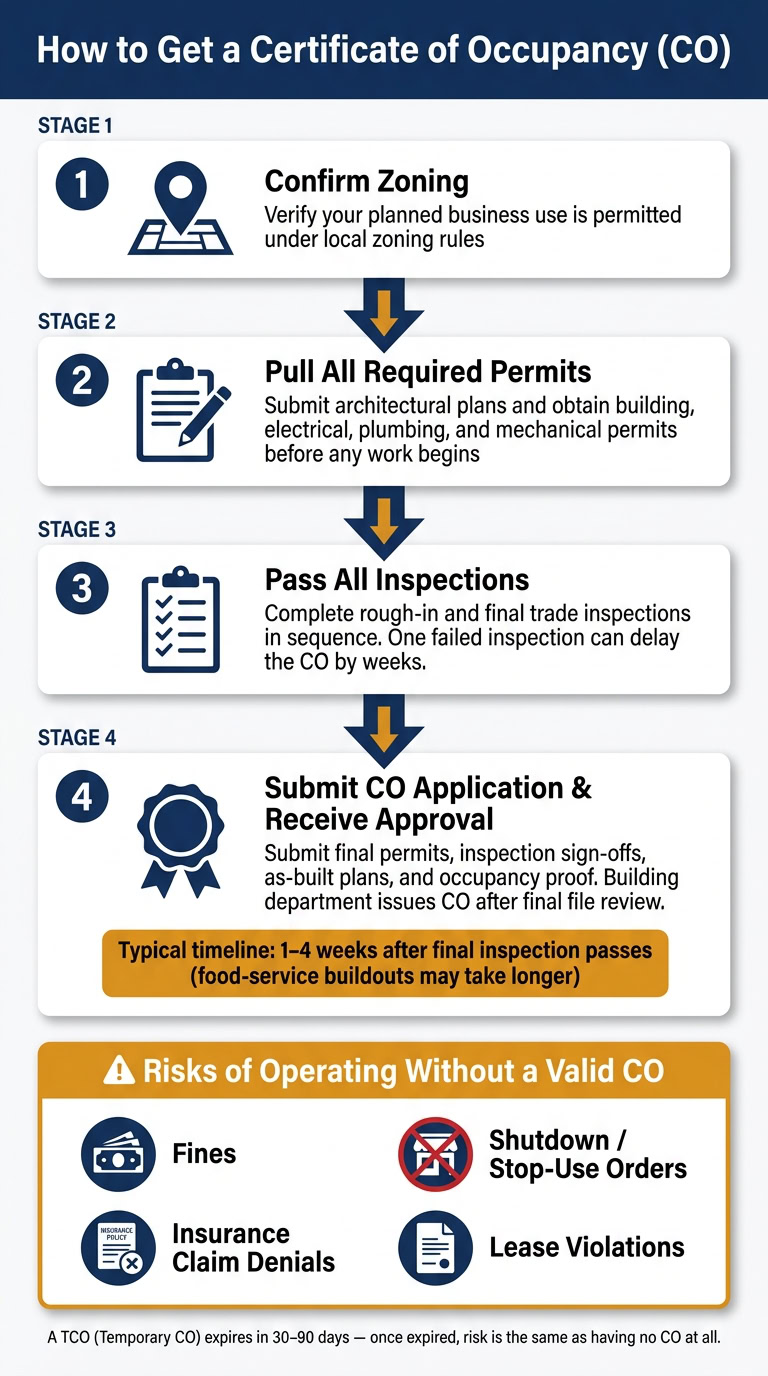
Once you know you need a CO, the path is pretty simple. In most cases, it comes down to four parts: zoning confirmation, permits, inspections, and final approval.
Start by making sure your planned use matches local zoning. Then submit your architectural plans to the building department and get every permit required before any work starts. That can include building, electrical, plumbing, and mechanical permits.
From there, move through the inspection process. You’ll need to complete each trade inspection before you ask for the final building inspection. It helps to leave room in your timeline for both rough-in and final inspections. If one inspection fails, the CO can get pushed back by weeks.
After all inspections pass, submit your CO application with the final permits, inspection sign-offs, as-built plans, and proof that you have the right to occupy the space. The building department then does a final file review and issues the CO.
The point is simple: you need to show that the space matches the use you plan.
Most tenant improvement projects get a CO within 1 to 4 weeks after the final inspection passes. Food-service buildouts often take longer because they may need extra fire and health approvals.
The risks of operating without a valid CO
Until the CO is issued, you’re not legally clear to open. If you start operating without a valid CO, you can run into fines, shutdown orders, insurance denials, and lease violations.
And this isn’t one of those rules people can just shrug off. A fire marshal or local government can issue a stop-use order or vacate order and shut the business down on the spot.
There’s also the insurance problem. If something goes wrong in a space without a valid CO, the carrier may deny property damage or liability claims. That can leave the owner personally exposed.
If you’re using a Temporary Certificate of Occupancy (TCO), keep a close eye on the expiration date. Once that TCO expires, the risk is the same as having no CO at all.
FAQs
Who issues a Certificate of Occupancy?
A Certificate of Occupancy is issued by your local government. In most cases, that means the building department, zoning department, or a city office like the Department of Licenses and Inspections.
Officials issue the certificate after they confirm the building or commercial space meets the safety standards, zoning rules, and building codes that apply to its intended use. The exact office can vary by location, so it’s smart to check with your city or county to find the right one.
Can I use my landlord’s existing CO?
It depends on your local rules and how you plan to use the space. In some cases, a landlord’s existing Certificate of Occupancy still works if your use lines up with the building’s approved use classification.
That said, some cities or counties want a new CO when a new tenant moves in or when the property changes hands. Before you rely on the current certificate, check with your local building or zoning department.
How long does it take to get a CO?
The time it takes to get a Certificate of Occupancy depends on your local jurisdiction and the scope of the project.
After construction wraps up, the final inspection and approval process usually takes 1 to 4 weeks.
Once the project passes final inspection, the certificate itself may take another 1 to 2 weeks to be issued. That said, some cities move much faster and provide it the same day or within 3 to 5 business days.
The best move is to check with your local building office. They can tell you what the timeline looks like in your area and whether expedited review is available.