
A laundromat can cost $200,000 to $1,000,000+ to start, and the LLC question is simple: you do not need one, but many owners use one for liability protection.
If I were sizing up this business, I’d focus on five things first:
- Demand: renter-heavy areas, busy competitors, and enough parking
- Numbers: startup costs, rent, utilities, and cash reserve
- Site fit: water, sewer, gas, and 400–800 amp three-phase power
- Entity choice: sole proprietorship vs. LLC
- Store performance: pricing, machine turns, repairs, and security
The big takeaway is this: a laundromat works when the location, utility setup, and machine use all line up. Revenue can hit $15,000 to $30,000 per month, but utility costs alone often take 15% to 25% of gross revenue, so a bad site can wreck the math fast.
If you want the short version, here it is:
- Buy existing: often $200,000 to $500,000
- Build new: often $250,000 to $1,000,000+
- Target machine use: about 4 to 6 turns per washer per day
- Breakeven: often around 3 to 4 turns
- LLC: not required, but common if you’re signing a lease or hiring your first employee
Quick Comparison
| Topic | Key Point |
|---|---|
| Business model | Self-service costs less to staff; full-service can make more per square foot |
| Main costs | Equipment, build-out, utilities, rent, and repairs |
| Best locations | Areas with 50% to 60%+ renters and household size above 2.5 |
| Utility warning sign | If utilities go above 25% of revenue, the setup may be off |
| Sole prop vs. LLC | Sole prop vs. LLC is a key choice; LLCs offer more protection than simpler structures |
| Before opening | Get permits, insurance, CO, and utility checks done before launch |
So if I were starting from scratch, I wouldn’t start with machines. I’d start with demand, site capacity, and risk – because those three calls shape almost every dollar you spend next.
sbb-itb-ba0a4be
1. Choose Your Laundromat Model and Confirm There Is Demand
Self-service, attended, and full-service laundromat models
Start with the model. That choice shapes your staffing, your space needs, and how much the store can earn.
A self-service (unattended) store usually runs with little to no staff, often from 6 a.m. to 11 p.m. The big upside is lower labor cost. The tradeoff is less upside from extra services. You also take on more risk from vandalism and theft, and you won’t be able to offer wash-and-fold service.
An attended or hybrid store puts staff on site to clean, help customers, and handle drop-off laundry. Payroll is usually $1,500 to $4,000 more per month than at an unattended store. In return, these stores tend to have less machine abuse and stronger customer service.
A full-service store goes a step further. It adds wash-and-fold, commercial accounts like gyms and clinics, and pickup and delivery. This is the most labor-heavy setup, but it can produce 30% to 50% more revenue per square foot than a self-service-only store.
How laundromats make money and where costs eat into margins
Most of the money comes from washer and dryer cycles. Self-service washes usually cost $2.50 to $6.00 for small loads and $8.00 to $12.00 for large 60 to 80 lb loads. Drying often adds $0.25 to $0.75 per increment. Wash-and-fold usually runs $1.25 to $3.00 per pound, depending on the market.
There are also smaller revenue streams that can add up:
- Detergent vending
- Snacks and drinks
- ATM fees
These extras can bring in more cash without much added labor.
On the cost side, rent, utilities, and maintenance put the most pressure on margins. Utilities alone – water, gas, and electricity – often take up 15% to 25% of gross revenue. A mid-size store may use 500 to 1,500 gallons of water per day. If utility costs go past 25% of gross revenue, that’s a red flag. Usually, the site costs too much to operate or the build-out doesn’t support the business well.
A solid store aims for 4 to 6 turns per washer per day. Breakeven usually lands around 3 to 4 turns.
How to research your local market before you commit
The clearest sign of demand is renter-heavy housing. Focus on areas where renter occupancy is high – ideally 50% to 60%+ – and average household size is above 2.5 people. That’s the core customer base for most laundromats.
Use ACS data to check renter-occupied housing, household size, and income. Then map nearby laundromats using NAICS code 812310. After that, go see the market for yourself. Visit competing stores during busy times, especially Sunday evenings and Monday nights. Look for things that customers notice right away:
- Out-of-order machines
- Poor cleanliness
- Pricing gaps
- Service gaps
That kind of field check tells you a lot fast.
Before signing anything, make sure the building can support the store. You want 400 to 800 amp three-phase electrical service and a water line larger than 3/4 inch. If the water line is too small, an upgrade can cost $10,000 to $30,000 before you even buy equipment. Check zoning and utility capacity before you commit to the lease.
With demand confirmed, the next step is pricing the build-out and equipment.
2. Plan the Numbers: Startup Costs, Location, and Equipment
Estimate startup costs and monthly operating expenses
Once you’ve confirmed demand, it’s time to see if the budget works on paper. Start with the big-ticket items. That gives you a clearer picture of what the store will cost before you get lost in smaller expenses.
Here’s a realistic cost breakdown for a new 20-machine store: Startup Item Low Estimate High Estimate
Totals are before contingency, signage, and opening inventory.
Equipment loans often require a 25% to 40% down payment.
Your monthly costs matter just as much as startup costs. If revenue looks good but utilities and rent eat the whole thing alive, the store can still struggle.
| Expense Category | Typical % of Revenue |
|---|---|
| Rent | 15% – 25% |
| Utilities (Water, Gas, Electric) | 15% – 30% |
| Labor (Attendants/Maintenance) | 0% – 20% |
| Maintenance & Repairs | 3% – 10% |
| Insurance & Marketing | 2% – 5% |
How to evaluate a location for plumbing, utilities, access, and lease terms
A laundromat lives or dies by the building behind it. A space may look perfect from the sidewalk, but if the utility setup is weak, the numbers can fall apart fast.
For example, upgrading an undersized water line can cost $10,000 to $30,000+, depending on how far the site is from the main. Electrical is another major checkpoint. If the building has a standard 200-amp retail panel instead of 400 to 800 amp, three-phase, you’re looking at a big added cost before you even place equipment orders.
Then there’s the customer side of the location. People hauling laundry baskets don’t want a long walk or a messy parking lot. Make sure the site has enough parking and easy access for drop-off and pickup traffic.
Lease terms matter too. Try to lock in at least 10 years with renewal options, since laundry equipment usually takes years to pay back. Ask for an exclusive-use clause so the landlord can’t put another laundromat in the same center. And get build-out responsibility in writing before anything starts.
Choose commercial laundry equipment that fits your store size and demand
Once the site passes the utility check, the next step is matching your machine mix to the space and the traffic you expect.
A mid-size store usually runs 20 to 40 washers and 20 to 35 dryers. In most cases, front-load washers should make up the core of the lineup. Add larger-capacity machines for comforters, bulky loads, and family-size wash days. For dryers, a good rule is about 1.5 dryer pockets per washer, which helps avoid backups when the store gets busy.
Dryer type also affects operating costs. Gas dryers are usually cheaper to run than electric models in most U.S. markets, but they need gas line installation and special venting. That can add to your setup bill, so it’s worth pricing both options early.
Payment systems can also shift revenue more than many owners expect. Cashless card or app-based systems can increase machine revenue by 15% to 20% compared with coin-only stores, though they also add $150 to $500 per machine upfront. These systems also make remote monitoring possible, so you can track machine status and revenue without being on-site all day. That’s a big help for unattended stores.
Set aside 5% to 10% of monthly revenue for maintenance and repairs. Machines take a beating in a busy laundromat, and repairs aren’t a matter of if – they’re a matter of when.
3. Decide Whether to Form an LLC and Register the Business
You do not have to form an LLC to open a laundromat. You can run one as a sole proprietor.
That said, many owners still go with an LLC. And the reason is pretty simple: laundromats come with real risk. Think wet floors, heavy machines, damaged customer items, and, in many cases, a commercial lease or staff on payroll.
Sole proprietorship vs. LLC for a laundromat
Once you’ve confirmed the store works on paper, the next call is deciding which business entity will hold the lease, the equipment, and the legal risk.
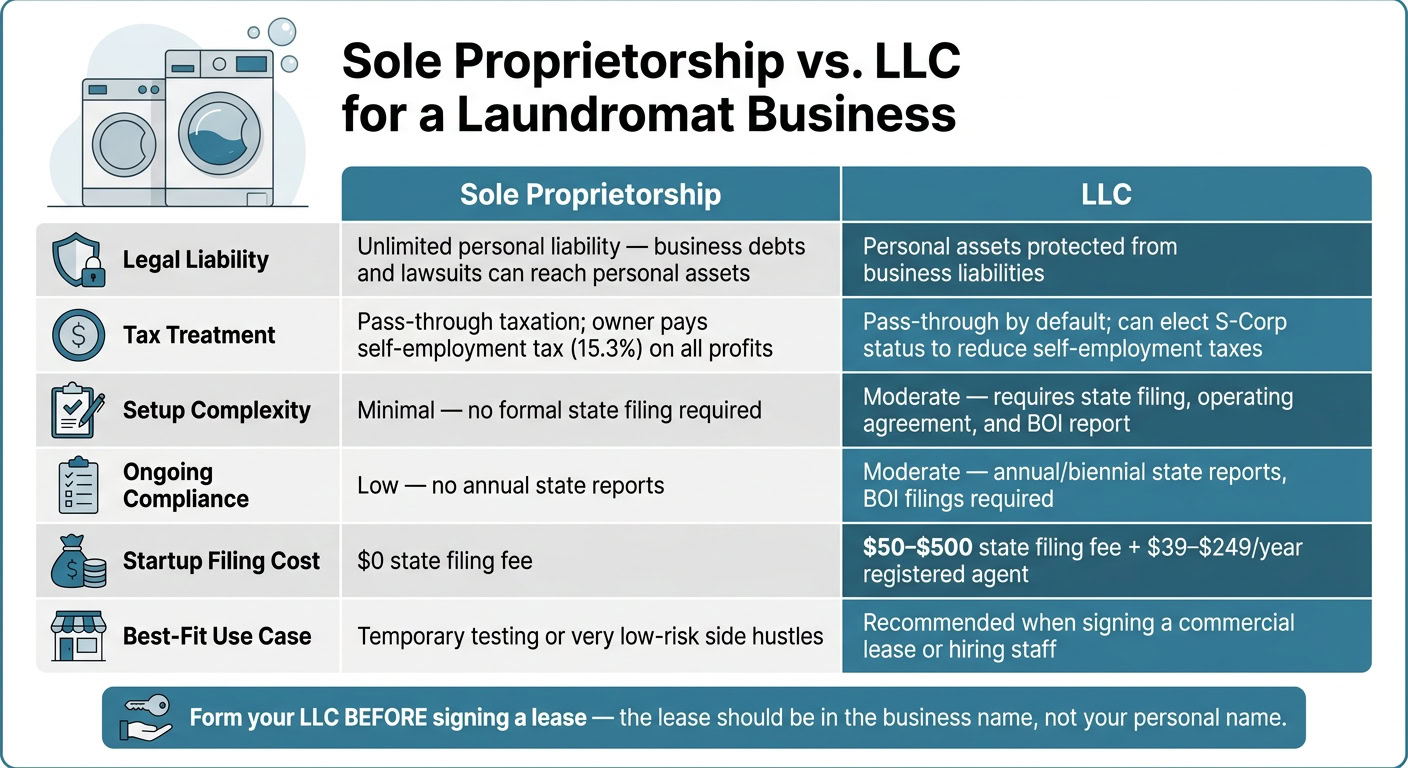
The big split is liability. As a sole proprietor, there’s no legal wall between you and the business. If the laundromat gets sued or owes money, your personal assets may be on the line. With an LLC, the business is set up as its own legal entity, so your personal assets are generally shielded from business claims.
| Feature | Sole Proprietorship | LLC |
|---|---|---|
| Legal Liability | Unlimited personal liability for business debts and lawsuits | Personal assets are protected from business liabilities |
| Tax Treatment | Pass-through; owner pays self-employment tax on profits | Pass-through by default; can elect S-Corp status later |
| Setup Complexity | Minimal; no formal state filing required | Moderate; requires state filing and an operating agreement |
| Ongoing Compliance | Low; no annual state reports | Moderate; requires annual or biennial reports and BOI filings |
| Best-Fit Use Case | Temporary testing or very low-risk side hustles | Best for owners signing a lease or hiring staff |
An LLC also gives you room to elect S-Corp status later. That can lower self-employment taxes by splitting income between salary and distributions. Self-employment tax is usually 15.3% of business income.
When an LLC makes sense for a single store, a lease, or employees
If you’re signing a commercial lease, form the LLC before you sign anything. The lease should be under the business name, not your personal name, so that long-term obligation sits with the company.
The same logic applies if you’re hiring attendants or maintenance staff. An LLC adds separation between job-related claims and your personal finances. It won’t solve every problem, but it does put a legal barrier in place.
How to register the business and complete core filings
If you decide to form an LLC, do it before you sign a lease or buy equipment.
- Choose a business name and check your state’s business database to make sure it’s available.
- Choose a registered agent service to receive legal notices. Registered agent services usually cost $39 to $249 per year.
- File Articles of Organization or a Certificate of Formation with the Secretary of State. Filing fees often run from $50 to $500.
- Get an EIN from the IRS. It’s free, and you’ll need it to open a business bank account.
- Draft an operating agreement that spells out ownership and control.
- Open a business bank account so business and personal money stay separate.
- File BOI reports with FinCEN.
With the entity set up, the next step is permits, insurance, and local compliance.
4. Get Licenses, Permits, Insurance, and Compliance in Place
After you register the entity and get an EIN, you still need local approval before you can open. This is the part where the business moves from idea on paper to store that can legally serve customers. Licenses, permits, and insurance all come into play here, and the exact mix depends on your city, county, state, and how much work the space needs.
Business licenses, build-out permits, and local approvals
Most laundromats need a general business license from the city or county where they operate. That usually costs $25 to $300 per year. Simple enough.
Things get more involved if you’re renovating the space or building from scratch. In that case, you’ll usually need separate permits for electrical, plumbing, mechanical work or gas lines for dryers, and structural work. Laundromats often need 400–800 amp three-phase service, so check the building’s water line size and electrical amperage before you sign a lease. If the site can’t support the store, that lease can turn into a headache fast. Building permits alone often cost $500 to $5,000, based on the scope of the project.
You also need a Certificate of Occupancy (CO) before opening to the public. This confirms that fire, building, and health inspections have been passed. No CO means no legal opening.
Because laundromats use a lot of water, some cities also require wastewater discharge approval or a sewer connection review. In some cases, that includes a lint or grease interceptor. If your projected water use is high enough to trigger industrial pretreatment review, contact the local water utility early.
A few other items are easy to miss but matter:
- Zoning clearance confirms the site is approved for commercial laundry use
- A sign permit may be needed for exterior signage
- ADA compliance applies to machine heights, payment terminals, and folding tables
Some places add extra agency review. In California, that can mean SCAQMD air quality permits for dryer exhaust. In New York City, expect a DEP wastewater review.
Insurance policies and ongoing filing obligations
Once permits are moving, get insurance lined up before build-out starts. Laundromats deal with wet floors, expensive machines, and the risk of having to shut down after damage or equipment failure. Insurance helps cover claims, legal defense, and recovery costs.
| Coverage Type | Why It Matters | Estimated Annual Cost |
|---|---|---|
| General Liability | Covers slip-and-fall accidents on wet floors and customer injuries | $800–$2,000 |
| Commercial Property | Protects washers, dryers, and build-out (often $150,000–$400,000 in value) | $1,000–$3,500 |
| Equipment Breakdown | Covers mechanical/electrical failure – often excluded from standard property policies | $300–$800 |
| Business Interruption | Replaces lost income if the store closes due to fire or major equipment failure | $400–$1,200 |
| Workers’ Compensation | Required by law in most states if you hire attendants or maintenance staff | $500–$2,000 |
You can often bundle general liability, property, and business interruption into a Businessowners Policy (BOP). That may cut combined premiums by 10% to 15%. For a mid-sized laundromat, total annual insurance usually falls between $3,000 and $8,000.
If you set up an LLC, stay on top of state reports, franchise taxes, and BOI record updates after ownership changes. Hiring staff adds another layer: you’ll need to register for payroll and unemployment taxes and report new hires.
Set up tools to manage mail, notices, and compliance deadlines
Once coverage is in place, the next job is keeping up with mail, filings, and renewal dates. This matters a lot once leases, permits, tax notices, and state reports start coming in on different schedules.
A registered agent receives legal notices and sends them to you promptly. A virtual mailbox can help you track business mail, tax documents, and permit renewal reminders. Used together, they give you one place for legal notices, tax paperwork, and deadline-related mail.
5. Open and Run the Laundromat at a Profit
Once permits are cleared and the machines are in place, the day-to-day work is what decides if the laundromat earns money.
Set up store operations, staffing, and security
Start with a simple opening routine each day. Test the machines, empty lint traps, restock vending, check payments, wipe down surfaces, and inspect the restrooms. At closing, reconcile cash and card sales, log any repairs, clean the store, and lock everything down.
It also helps to keep a service log for each machine. That gives you a repair history and helps you catch small issues before they turn into expensive ones. On top of that, plan for weekly deep cleaning and quarterly equipment inspections.
Security matters more than many first-time owners expect. A good setup usually includes 8 to 16 cameras with cloud recording, aimed at machine rows, folding tables, and entry points. Bright LED lighting at 50 foot-candles or more can help cut down on loitering and vandalism. Cashless or hybrid payment systems can also lower theft risk and make end-of-day reconciliation easier.
Staffing depends on the size and setup of the store. Smaller laundromats with about 10 to 20 machines are often run by the owner. Stores with 30 or more machines usually need part-time attendants. If you add wash-and-fold, you’ll need more hands for sorting and folding. And if you’re hiring, get payroll, tax withholding, and workers’ compensation set up before opening day.
Price your services and track the numbers that drive profit
When the store is running well, pricing and machine use are what shape your margins.
Start with your own costs: rent, utilities, labor, and maintenance. Then compare those numbers with nearby competitors. Check laundromats within 1 to 2 miles and see where they land on price. If your store is cleaner or has newer equipment, you may be able to charge a bit above the local average.
Typical self-service wash prices are about $3.00 to $12.00 per load, based on machine size. Dryers often run $0.25 to $0.75 per 4-minute increment.
Use the same rent, utility, and labor assumptions from your startup plan to judge whether the store is performing the way it should. Track a small set of numbers every week:
| KPI | Target | Why It Matters |
|---|---|---|
| Turns per Day | 4–8 per machine | Shows how often equipment is used |
| Utility Cost % | 15%–20% of gross revenue | Main sign of utility efficiency |
| Labor Cost % | 10%–15% of revenue | Shows payroll efficiency in attended stores |
| Maintenance Budget | 5%–10% of monthly revenue | Pays for repairs and supplies |
A laundromat doesn’t make money just because it’s busy. It makes money when costs stay under control. If utility costs climb above 20% of revenue, inspect for leaks or older machines that are eating up water, gas, or electricity.
Conclusion: The clearest path from idea to opening day
Starting a laundromat is mostly about doing the right things in the right order: pick the model that fits your market, build a startup budget based on actual costs, confirm the location has enough utility capacity before you sign the lease, secure equipment and permits, and then run tight daily systems that keep costs in check and machines in use.
If you choose to form an LLC, it may help shield your personal assets from lawsuits, though that shield isn’t absolute, which is why insurance still matters. A solid insurance mix – general liability, equipment breakdown, business interruption, and workers’ compensation – can help protect the business when something goes sideways.
FAQs
Can I start a laundromat with financing?
Yes. A lot of owners use financing to start or buy a laundromat because startup costs often fall between $200,000 and more than $1,000,000.
Common funding options include:
- SBA loans
- Equipment financing
- Seller financing, in some cases, when you’re buying an existing laundromat
Lenders also often want you to set up a formal business entity, such as an LLC, before they approve business or equipment financing.
How do I know if a laundromat location is truly profitable?
Do thorough due diligence within a 1 to 3-mile trade area. Start with local demographics, with extra attention on renter-heavy neighborhoods, large apartment complexes, and places where in-unit laundry is limited or missing.
Then look closely at nearby competitors. Check the age of their machines, how clean the store is, what they charge, and how busy they get during peak hours. A quick visit at the wrong time can miss the whole picture, so it helps to see the traffic for yourself.
You should also review at least 24 months of utility bills to verify actual operating costs. That step matters more than many buyers think. On paper, numbers can look fine. In practice, water, gas, and electric bills can tell a very different story.
Before signing a lease, confirm that zoning, utility capacity, and lease terms all support laundromat operations. If any one of those is off, the deal can go sideways fast.
What happens if I open a laundromat without an LLC?
If you open a laundromat as a sole proprietor instead of an LLC, there’s no legal line between your business and your personal finances. That means if someone sues the business over an injury, a machine issue, or property damage, your home, car, and savings could all be on the line.
There’s also a money side to this. Getting equipment financing or SBA loans can be harder, since many lenders prefer – or flat-out require – a formal business entity.