

Copyright licensing across borders is complex due to territorial laws. Here’s what you need to know:
- Copyright is territorial: Laws differ by country, and international agreements like the Berne Convention provide a framework for protection.
- Understand local laws: Research copyright rules, such as fair use (broad in the U.S., limited in Japan), moral rights, and registration benefits.
- Define licensing terms: Specify the scope, permitted uses, territorial limits, and financial arrangements (e.g., royalties, payment terms).
- Monitor and enforce compliance: Use tools like audits, customs registrations, and international arbitration to protect your rights globally.
This guide outlines the key steps for navigating international copyright licensing effectively.
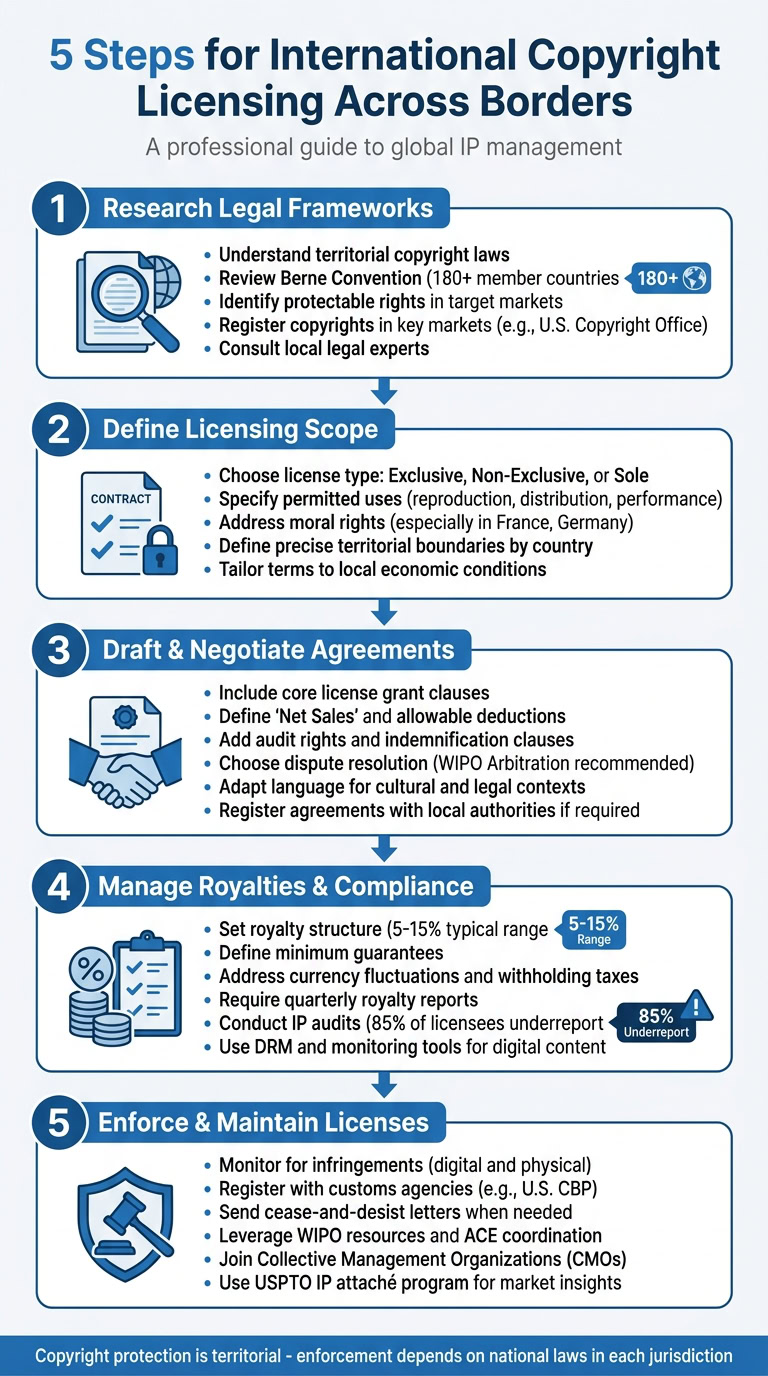
Step 1: Research Legal Frameworks and Requirements
Understanding the legal frameworks in each target market is crucial because copyright laws operate on a territorial basis – each country enforces its own rules. As Michael S. Denniston, Partner at Bradley Arant Boult Cummings LLP, explains:
Copyright law is ‘territorial’ and national in scope. Regardless of where the author lives or where the work was first published, the copyright protection afforded to a work depends on the national laws of the country in which the author seeks protection.
International agreements like the Berne Convention and the WIPO Copyright Treaty provide a foundation for copyright protection. The Berne Convention, which includes over 180 member countries, ensures automatic protection without requiring formal registration. These treaties set a baseline, but each country’s specific laws determine which rights are protected and how.
Identify Protectable Rights in Target Markets
Copyright protections vary widely between countries. While the Berne Convention establishes minimum standards – such as protection for the life of the author plus 50 years – individual nations often impose additional rules. Key considerations include work-for-hire ownership, moral rights, and fair use exceptions, all of which differ significantly across jurisdictions.
For instance, the U.S. has a broad "fair use" doctrine, allowing uses like parody or commentary without infringement. In contrast, Japan doesn’t recognize fair use at all, granting only limited exceptions for purposes like news reporting, criticism, or academic research. These differences can influence how you draft licensing agreements and define the rights you can grant in each market. Understanding these distinctions is essential for navigating copyright laws and structuring agreements effectively.
Register Copyrights in Key Markets
Registering copyrights in key markets like the U.S. offers practical advantages. Filing with the U.S. Copyright Office provides prima facie evidence of ownership, which can strengthen your position in foreign courts. It’s also a prerequisite for filing infringement lawsuits in U.S. federal court and for claiming statutory damages or attorney’s fees.
Additionally, you can record your copyright with U.S. Customs and Border Protection (CBP), enabling customs officials to monitor and seize counterfeit goods at the border. Including a copyright notice – using the © symbol, year of publication, and owner name – on all published works further discourages infringement and establishes public notice. These steps enhance the protections provided by international treaties and ensure a stronger legal foundation.
Before entering any new market, it’s essential to consult with local legal experts to understand the enforcement mechanisms and procedural requirements specific to that jurisdiction. This ensures your rights are protected and your approach aligns with local laws.
sbb-itb-ba0a4be
Step 2: Define Licensing Scope and Terms
When setting up a licensing agreement, it’s crucial to define the type of license you want to offer. You can choose between exclusive, non-exclusive, or sole licenses, each offering varying levels of control and opportunity:
- Exclusive License: Grants one partner full rights within a specific territory. This option is ideal for emerging markets where partners need assurance to invest heavily.
- Non-Exclusive License: Allows multiple partners to operate in the same region. This approach works well in established markets, spreading risk while maximizing reach.
- Sole License: Balances exclusivity by letting you retain usage rights while granting them to one partner.
After deciding on the license type, make sure to outline the specific uses allowed under the agreement.
Specify Permitted Uses and Restrictions
Lay out every right you’re granting, such as reproduction, distribution, public performance, display, or the creation of derivative works. Be as specific as possible about permissions. For example:
- Whether translations are allowed
- If distribution can be physical, digital, or both
- Whether sub-licensing is permitted (and if so, whether you retain approval rights and receive a share of the revenue)
Additionally, address moral rights, especially when licensing in countries with civil law systems like France and Germany. These jurisdictions treat moral rights – such as the right to attribution and the right to oppose derogatory changes to the work – as nearly untouchable. As outlined in the Berne Convention:
Independently of the author’s economic rights, and even after transfer of the said rights, the author shall have the right to claim authorship of the work and to object to any distortion, mutilation or other modification… which would be prejudicial to his honor or reputation.
In contrast, the U.S. provides limited moral rights protections under the Visual Artists Rights Act (VARA), which only applies to certain types of visual art like paintings or sculptures in limited editions.
Address Geographic and Jurisdictional Variations
Be precise when defining territorial boundaries – list specific countries instead of broad regions like "Asia" or "Europe." This clarity helps avoid disputes and ensures local copyright laws are applied correctly. As Andrea L. Arndt, Partner at Dickinson Wright PLLC, explains:
The National Treatment principle dictates that a work’s copyright is governed by the laws of the country where protection is sought.
Tailor your terms to fit the economic and legal conditions of each market. For example, a royalty structure that works in the U.S. may not be appropriate in regions with lower profit margins or weaker enforcement capabilities. Similarly, copyright concepts like "fair use" vary widely. In Japan, for instance, there is no general fair use doctrine – exceptions are limited to areas like news reporting, criticism, or academic research. Your licensing terms must account for these differences to ensure they are enforceable and compliant wherever rights are granted.
Step 3: Draft and Negotiate Licensing Agreements
To solidify your licensing scope, create a clear, enforceable written agreement. This step builds on your earlier legal research and defined licensing terms, ensuring your international copyright licensing is thorough and practical. Pay close attention to financial details and legal safeguards, especially in international contexts.
Include Required Clauses in Licensing Agreements
Start with the core license grant. This should specify the copyrighted work, permitted uses (like manufacturing, distributing, or selling), and the applicable territory. Use language such as "hereby grants" to clearly establish the license.
Financial terms need to be explicit. Define "Net Sales" by listing allowable deductions like taxes, duties, shipping costs, insurance, and standard discounts. Include audit rights to verify compliance and address withholding taxes to ensure you receive the intended net revenue.
Add representations, warranties, and indemnification clauses to confirm your right to license the work and protect against misuse. Clarify how adaptations will be handled, including ownership rights and confidentiality obligations.
Set clear terms for the license duration and termination conditions, like breaches, bankruptcy, or changes in control. If sublicensing is allowed, specify whether the licensee can grant sublicenses to affiliates or subcontractors. Make sure these sublicenses automatically terminate if the main agreement ends.
For dispute resolution, choose a method suitable for international agreements. Arbitration, such as under WIPO Arbitration Rules, often provides more flexibility and easier enforcement across borders compared to litigation. As Cooley notes:
Selecting one governing law over another may have a significant impact on your ability to protect or enforce your rights to intellectual property under a contract.
In some countries, you may need to register the agreement with local authorities or translate it into the native language for it to be enforceable. Tailoring these clauses to each market’s requirements is essential.
Adapt Agreements for Cultural and Legal Contexts
Once you’ve defined the core clauses, adjust them to meet the legal and cultural norms of each target market. Since copyright laws vary by country, an agreement valid in the U.S. might not hold up elsewhere. Think of your contract as a base document that requires localized adjustments for each jurisdiction.
Use straightforward and culturally appropriate language to enhance enforceability across borders. As PatentPC advises:
The clearer your terms, the easier it is to enforce them anywhere.
Modify fee structures to match local practices. In markets where large upfront fees are rare, consider tiered or performance-based payout models. Also, identify tax triggers to avoid complications like double taxation.
Cultural differences in negotiation styles are another factor. In some regions, building trust and relationships is essential, while others may prefer a more direct approach. Collaborating with local legal experts ensures that both the language and the underlying legal assumptions in your agreement align with local norms. This directly impacts your ability to manage royalties and enforce licensing rights effectively.
Step 4: Manage Royalties and Compliance
Once your licensing agreements are finalized, the next step is managing royalties and ensuring compliance. Effective royalty management is crucial for maintaining steady cross-border revenue. Without proper systems in place, you could face underpayments, disputes, or strained relationships with your licensees.
Establish Royalty Structures and Payment Terms
To secure your revenue, it’s essential to clearly define how royalties will be calculated and paid. There are several royalty structures to choose from, including:
- Percentage-based: A share of revenue (e.g., gross or net sales).
- Lump-sum: A one-time payment.
- Milestone-based: Payments triggered by specific achievements.
- Hybrid: A combination of upfront fees and ongoing royalties.
Percentage-based royalties are common, often ranging from 5% to 15% of revenue, though the exact rate depends on the industry. If you go this route, be specific about what the royalty is based on – gross revenue, net sales, units sold, or profit. Terms like "net sales" should be clearly defined, along with deductible expenses (e.g., marketing, taxes, or manufacturing costs), to avoid disputes. As IIPRD points out:
The less the clarity of such terms as ‘net revenue,’ ‘territory,’ or ‘field of use,’ the greater the chances that they will provoke and eventually lead to legal wrangling.
You might also consider minimum guarantees, which are baseline payments the licensee must make regardless of sales. This ensures a revenue floor and motivates the licensee to actively commercialize your intellectual property (IP). Tiered royalty structures can also be useful – such as 5% on the first $1,000,000 in sales, increasing to 7% for sales beyond that threshold.
For international agreements, address potential issues like currency fluctuations and withholding taxes upfront. Many countries require licensees to withhold a portion of royalty payments for local taxes. Your agreement should specify who is responsible for these taxes and how they will affect net payments. Additionally, include clauses granting you the right to audit the licensee’s financial records periodically to verify accuracy. To encourage timely payments, consider adding late payment penalties, typically around 1–2% monthly interest.
Monitor Compliance and Conduct IP Audits
Once payment terms are in place, regular monitoring is essential to ensure compliance and protect your revenue. Studies show that 85% of licensees underreport royalties, with 25% significantly undervaluing their payments. To avoid this, require licensees to submit detailed royalty reports on a quarterly basis, ensuring consistent cash flow and accountability.
IP audits play a key role in verifying compliance. These audits typically involve four phases:
- Agreement Analysis: Reviewing the terms of the agreement, including rights and royalty rules.
- Data Collection: Gathering sales records, production logs, and invoices.
- Comparison and Verification: Cross-checking reported data against actual operations.
- Findings Reporting: Documenting discrepancies and addressing them with the licensee.
For digital content and software, tools like Digital Rights Management (DRM), watermarking, and licensing dashboards can help monitor usage and payments in real time across multiple regions. Engaging independent third-party auditors with expertise in IP law and royalty accounting can further ensure neutrality and reduce tension between you and your licensees. As Ocean Tomo explains:
Trust but verify is more than a phrase. It is a proven approach to safeguarding multi-million-dollar revenue streams.
Your agreements should include detailed audit clauses specifying how often audits can be conducted, who bears the cost (often shifted to the licensee if underreporting exceeds a certain threshold), and which records must be made available for review. Taking these proactive steps not only protects your revenue but also fosters stronger, more transparent relationships with your licensees across borders.
Step 5: Enforce and Maintain International Licenses
Once licensing terms and royalty structures are established, the next critical step is ensuring these rights are upheld worldwide. Since copyright protection is territorial, enforcement is subject to the national laws of the country where the protection is being pursued.
Monitor for Infringements and Take Action
Keeping an eye out for copyright violations is essential, and it requires a mix of digital and physical strategies. For digital works, tools like DRM (Digital Rights Management), watermarking, DOIs (Digital Object Identifiers), and timestamps help track your content and provide proof in case of infringement.
When it comes to physical goods, customs recordation is a key defense. By registering copyrights with national customs agencies – like the U.S. Customs and Border Protection (CBP) e-Recordation program – you empower border officials to identify and stop counterfeit goods before they hit the market. To assist customs authorities, provide detailed product guides and consider organizing training sessions at key ports of entry.
A notable example of this in action occurred in February 2026, when the National Intellectual Property Rights Coordination Center’s "Operation Team Player" intercepted 276,392 counterfeit sports items worth $33.4 million in the lead-up to Super Bowl 60. If you detect infringement, a good starting point is sending a cease-and-desist letter and submitting takedown requests to the relevant ISP.
Beyond these immediate steps, tapping into international resources can amplify your enforcement efforts.
Use International Authorities and Resources
International organizations and agreements can play a crucial role in protecting your copyrights across borders. The Berne Convention, which includes over 180 member countries, operates on the "National Treatment" principle. This ensures that foreign authors receive the same protections as domestic ones in member countries. For example, a U.S. copyright registration can serve as compelling evidence of authorship, even if a foreign court applies its local laws.
The World Intellectual Property Organization (WIPO) also provides valuable support. WIPO administers key treaties and runs the Advisory Committee on Enforcement (ACE), which coordinates international copyright protection efforts. If disputes arise, WIPO’s Arbitration and Mediation Center offers cost-effective and faster resolution options, like mediation and arbitration, as alternatives to traditional litigation. Additionally, joining Collective Management Organizations (CMOs) in target markets can help you monitor the use of your works, negotiate licenses, and take legal action against infringers.
To gather market-specific insights, take advantage of resources like the USPTO IP attaché program and Country Commercial Guides available through U.S. embassies. These tools provide detailed information on intellectual property laws in over 140 countries. However, always consult with local legal experts before proceeding in foreign markets, as copyright doctrines vary widely. For instance, Japan does not have a broad "fair use" doctrine and only allows limited, specific exceptions.
Conclusion
Cross-border copyright licensing is no simple task. It requires careful planning and execution across several key areas: thorough legal research, clear licensing scope definition, effective negotiations, and structured royalty management. Since copyright protection is territorial, enforcement depends on the specific laws of each jurisdiction. This means your approach must be tailored to accommodate differences in legal doctrines, moral rights, and enforcement mechanisms.
The Berne Convention’s principle of National Treatment guarantees equal protection internationally. However, while this ensures automatic protection in member countries, proactive steps like registration and documentation are still essential. In the U.S., registration plays a critical role in proving ownership. This legal foundation should align with efficient management systems to keep everything running smoothly.
"Licensing globally isn’t about complexity. It’s about coordination." – PatentPC
Centralized systems are a game-changer for tracking agreements, ensuring compliance, and avoiding overlaps. For businesses navigating international licensing, modern platforms provide the tools to stay on top of it all. For example, platforms like BusinessAnywhere simplify compliance for U.S.-based entrepreneurs managing operations remotely. From maintaining registered agent services in multiple states to handling annual filings and trademark applications, these tools offer a 24/7, user-friendly dashboard to keep everything in check.
FAQs
Do I need to register my copyright in every country?
You don’t have to register your copyright in every country. Thanks to international agreements like the Berne Convention, your work is automatically protected in member countries. That said, the level of protection can vary based on each country’s laws and specific agreements. It’s always a good idea to check local regulations to make sure your copyright is properly secured.
How do I pick the right governing law and venue?
When deciding on the governing law and venue for an international copyright licensing agreement, it’s crucial to evaluate the legal systems of the jurisdictions involved. Pay attention to factors like contract enforceability and any specific formalities required. Opt for a governing law that provides straightforward and consistent intellectual property regulations. Similarly, select a venue that offers legal neutrality, familiarity for both parties, and ensures judgments can be enforced effectively.
Additionally, be aware of local requirements regarding contract language and registration. These details play a key role in making sure the agreement is clear and enforceable for everyone involved.
How can I prevent royalty underreporting abroad?
To address the issue of royalty underreporting overseas, start by drafting clear international licensing agreements. These agreements should spell out royalty reporting requirements and include provisions for audit rights. Strengthen your position by registering copyrights internationally through treaties such as the Berne Convention, which enhances enforcement capabilities.
Stay proactive by regularly monitoring royalty payments and conducting audits to ensure compliance. Familiarize yourself with global legal frameworks like the World Intellectual Property Organization (WIPO) and TRIPS agreements, as they provide guidance on protecting intellectual property rights worldwide.
Additionally, consider using platforms like BusinessAnywhere to simplify compliance and documentation. These tools can help you efficiently manage licensing processes and enforce royalty payments with greater ease.