

A holding company is a parent business that owns other businesses or assets, while those other companies do the daily work. I’d sum it up like this: you use it to separate risk, split assets from business activity, and keep ownership at the top. But each entity needs its own bank account, records, tax setup, and filings – or the structure can fall apart.
Here’s the short version:
- The parent owns.
- The subsidiaries run the business.
- Assets like real estate, equipment, or trademarks can sit in a separate entity.
- The main goal is liability separation, not tax elimination.
- The cost can add up fast with filing fees, annual reports, registered agent services, and state taxes like California’s $800 LLC franchise tax.
- This setup fits best if you own multiple businesses, separate properties, or assets you want apart from daily business risk.
If I were explaining it to a friend, I’d say this: one company holds the pieces, and the other companies do the risky work. That’s the whole idea. The tradeoff is simple too: more separation means more paperwork.
| Setup | Main Job | Main Risk |
|---|---|---|
| Parent company | Owns subsidiaries or assets | Low if it stays out of daily business |
| Operating company | Handles staff, contracts, and sales | Direct business risk |
| Asset-holding company | Owns property, equipment, or IP | Risk tied to that asset, not daily business activity |
Bottom line: if you keep each entity separate in both paper records and money flow, this structure can help contain problems. If you mix funds or skip records, the shield gets weak fast.
How a holding company structure works
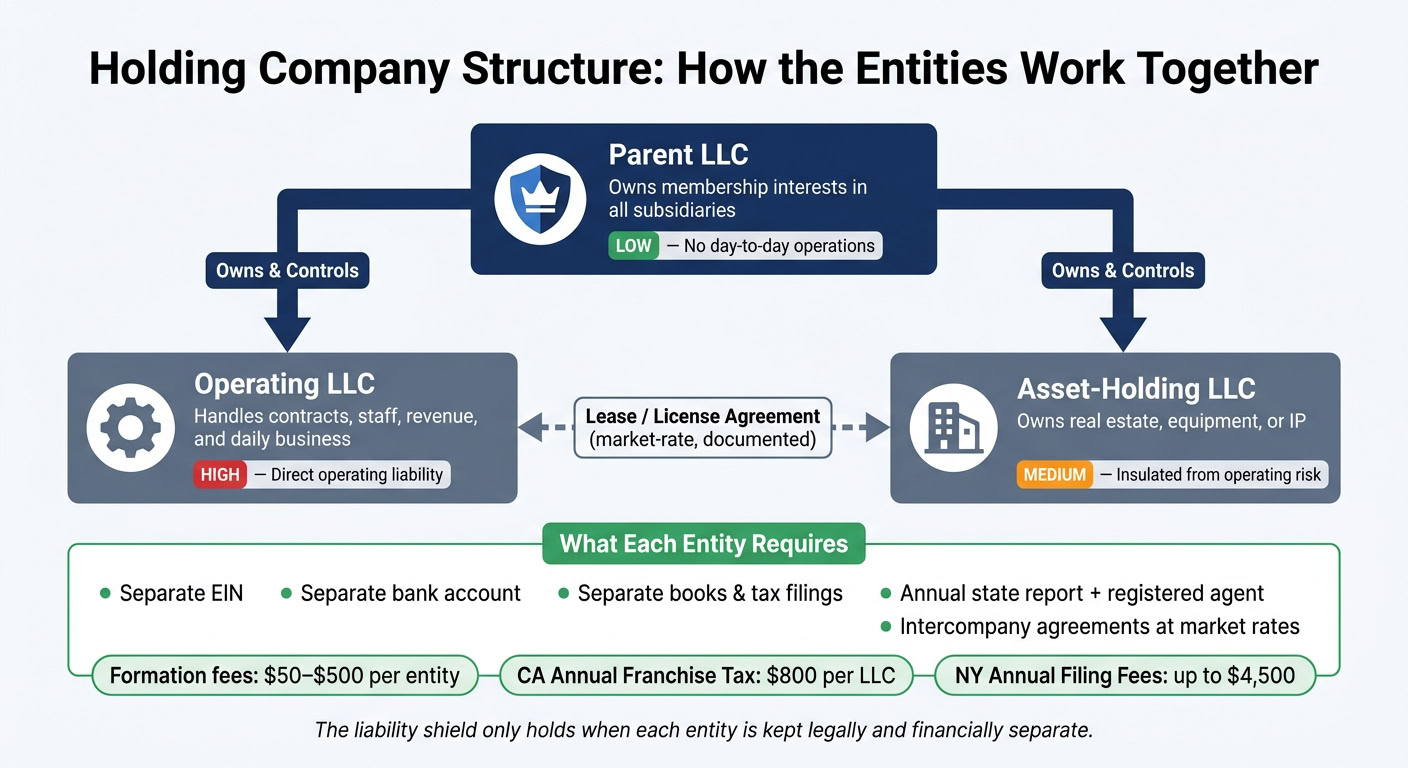
This setup usually works through a parent entity and one or more subsidiaries. Think of it as a two-layer structure.
At the top, the parent entity controls one or more subsidiaries through LLC membership interests or corporate shares. The parent handles major governance decisions. Each subsidiary handles its own contracts, employees, revenue, and day-to-day operating risk.
That separation matters on paper and in practice. Keep separate formation documents, bank accounts, books, tax records, and ownership records for each entity. Those lines help support the liability shield owners are trying to keep in place.
Parent company, subsidiaries, and operating companies
The parent owns the subsidiaries. In a pure holding company structure, the parent does not run daily business activity. Instead, it focuses on ownership, strategy, and major governance decisions.
The subsidiaries can each play a different role. Some are operating companies that run the business itself. Others hold real estate, intellectual property, vehicles, equipment, or other high-value assets. An operating company usually handles contracts, employees, billing, and revenue. Each subsidiary should have a clear job and its own records.
Here are two common ways owners use this setup.
Example: One parent LLC owning multiple operating LLCs
Say a founder forms a parent LLC and uses it to own three separate LLCs: one for an e-commerce store, one for consulting services, and one for a rental property. In that case, the parent LLC is listed as the owner of each subsidiary, instead of the founder owning all three businesses directly.
Each LLC has its own risk profile. So if one business runs into trouble, that issue is less likely to spill over into the others, assuming the entities are kept separate.
Example: Real estate in one entity, operations in another
Another common setup is to place a building, warehouse, or piece of equipment in one LLC, then have a separate operating LLC use that asset in the business. The property LLC owns the asset and leases it to the operating LLC at a documented fair-market rate. The lease and related records should be documented like an arm’s-length deal.
| Entity | What It Owns or Does | Risk Exposure |
|---|---|---|
| Parent LLC | Membership interests in subsidiaries | Low – no day-to-day operations |
| Operating LLC | Contracts, staff, revenue, daily business | Direct operating liability |
| Asset-holding LLC | Real estate, equipment, or IP | Better insulated from operating risk |
Once the structure is clear, the next step is choosing the right entities and forming them in the right order.
sbb-itb-ba0a4be
How to set up a U.S. holding company step by step
Choose the entity type and state of formation
For most small businesses, an LLC parent is usually the simplest path. It gives you pass-through taxation, flexible management, and fewer formal requirements than a corporation.
The state you pick matters because it affects both cost and compliance. Before you file, compare filing fees and annual state taxes. A low upfront fee can look good at first, then sting later if the annual costs are high.
After you choose the parent entity and the state, you can move on to setting up the subsidiaries under that parent.
Form the parent first, then create or transfer subsidiaries
Start by forming the parent company. Then create each subsidiary with the parent named as the owner.
If you’re moving an existing business into the structure, use a written assignment of interest. Then update the operating agreement and company records so the ownership trail is clear and clean.
Keep legal and financial separation from day one
A holding company structure only works if each entity is treated as separate in day-to-day use, not just in the paperwork.
That means each entity should have its own bank account, EIN, and bookkeeping. If one company pays another, leases from another, or charges a management fee, put it in writing and use market-rate terms. If you mix funds, you weaken the liability shield.
Once the structure is set up, the next issue is whether the upside is worth the extra compliance.
Benefits, limits, and tradeoffs of this structure
Why owners use holding companies
The main reason owners set up this kind of structure is liability isolation. When each line of business sits inside its own subsidiary, a lawsuit or debt will usually stay with that entity, as long as the companies are funded the right way and the paperwork is kept in order.
That separation also helps protect assets. A common setup looks like this: the holding company owns the trademarks, software, or templates, while the operating LLC handles client contracts and employs the team.
The other big draw is centralized control. The parent company sets direction, moves capital where it needs to go, and owns the subsidiaries. Each operating company can then stay focused on its own work. This setup also makes growth less messy. If you want to launch a new product line or buy another rental property, you can form a new subsidiary instead of tearing apart what you already built.
Where the structure can fall short
There’s a catch: this setup comes with more admin work and more cost. Every entity needs its own state filing, registered agent, EIN, separate bank account, and annual report. Formation fees usually fall between $50 and $500 per entity, and annual report fees are often in that same range. In California, LLCs face a minimum $800 annual franchise tax. In New York, annual filing fees can go as high as $4,500 based on gross income.
The bookkeeping side gets heavier too. You need separate books, separate tax filings, and formal intercompany agreements whenever the parent and a subsidiary do business with each other. If subsidiaries operate across state lines, you may also run into foreign qualification rules and tax duties in more than one state.
The biggest danger is piercing the corporate veil. If records are sloppy or money gets mixed between entities, a court can decide that separation doesn’t hold up. And it’s worth being plain about this: a holding company doesn’t wipe out taxes or make liability vanish. Each entity still owes any federal, state, and local taxes that apply. Owners can still face personal liability for personal guarantees, fraud, or their own negligent acts. In other words, the shield only works if each entity is kept up the right way. That’s why compliance isn’t just paperwork. It’s the whole game.
Ongoing compliance and when a holding company makes sense
Compliance tasks for each entity in the structure
The upside of this setup only lasts if each entity stays in good standing. And that means each one has its own filing duties, its own records, and its own deadlines.
At the state level, each entity will usually need its own annual or biennial report, registered agent, and entity-level fee. In California, for example, LLCs pay an $800 annual franchise tax no matter how much money they make. If you have three or four entities, those costs can pile up fast.
And state filings are just one piece of it. At the federal level, you also need to follow current beneficial ownership reporting rules. Filing duties depend on the entity type and whether an exemption applies. Updates are required only when the reported information changes.
There’s also the day-to-day side of keeping entities separate. Each one needs:
- Its own books
- Its own bank account
- Its own tax return or schedule
If the parent leases property to a subsidiary or licenses a trademark to it, put that in a written intercompany agreement. The terms should match market rates, and the payments should be documented. The same goes for major decisions. If you add a new subsidiary or change ownership, record it with written consents or meeting minutes for each entity involved.
This is the part many owners underestimate. The legal split between the parent and each operating company doesn’t survive on paper alone. It depends on clean records and steady follow-through.
A simple way to stay on top of it is to build one central compliance calendar. List every entity, its state of formation, and every recurring deadline. Then assign one person – inside your company or outside it – to own that calendar and confirm filings after they go through. Track each entity on its own, not as part of a blended group.
Who should consider this setup and key takeaways
This is the tradeoff: more separation, more paperwork.
A holding company setup makes sense for owners who need to split risk across entities. A real estate investor, for example, may want separate LLCs for separate properties under one parent entity. That’s a clean use case.
It’s a poor fit for someone running one small, low-risk business who already has trouble keeping up with a single entity’s filings. More entities won’t fix that. If anything, it adds more chances to miss deadlines, mix funds, or lose track of records.
The basic rule is simple: the parent owns, the subsidiaries operate. But that rule only works when each entity is treated like its own legal and financial unit. Separate accounts. Separate records. Separate agreements. Once those lines start to blur, the liability shield can weaken.
| Situation | Holding company fit | Key compliance load |
|---|---|---|
| Multiple businesses with different risks | Strong fit | Separate filings, books, and intercompany records per entity |
| Real estate separated from operations | Strong fit | Annual reports, franchise taxes, registered agent, and lease documentation |
| Single small business, limited assets | Weak fit | More filings and formalities than a single-entity setup adds cost without clear benefit |
FAQs
Can one LLC be both a holding company and an operating company?
Yes. An LLC can act as both a holding company and an operating company.
But in many cases, that’s a bad setup for liability protection.
If the same LLC owns assets and handles day-to-day business activity, those assets may be at risk if the business gets sued or runs into debt. That’s why many owners split those jobs between separate entities. The idea is simple: keep a lawsuit or debt tied to one business from putting other assets on the line.
Do I need a separate EIN and bank account for each entity?
Yes. Each subsidiary or series LLC should have its own EIN and its own bank account.
That separation matters. When tax IDs, bank accounts, records, and finances stay separate, it helps preserve liability protection and shows that each entity stands on its own as a legal business.
If you mix funds or blur those lines, you can weaken asset protection.
How do I move an existing business into a holding company structure?
You’ll usually move from a single-entity setup to a parent-subsidiary structure.
First, form a parent LLC, often in Wyoming, Nevada, or Delaware. Then shift your operating businesses under that parent as separate subsidiaries.
Each subsidiary should keep its own EIN, bank account, and operating agreement. You’ll also want to document intercompany transactions at arm’s length and take care of any needed tax filings, such as Form 8832.