


No, you don’t need a lawyer to start an LLC, but it depends on your situation.
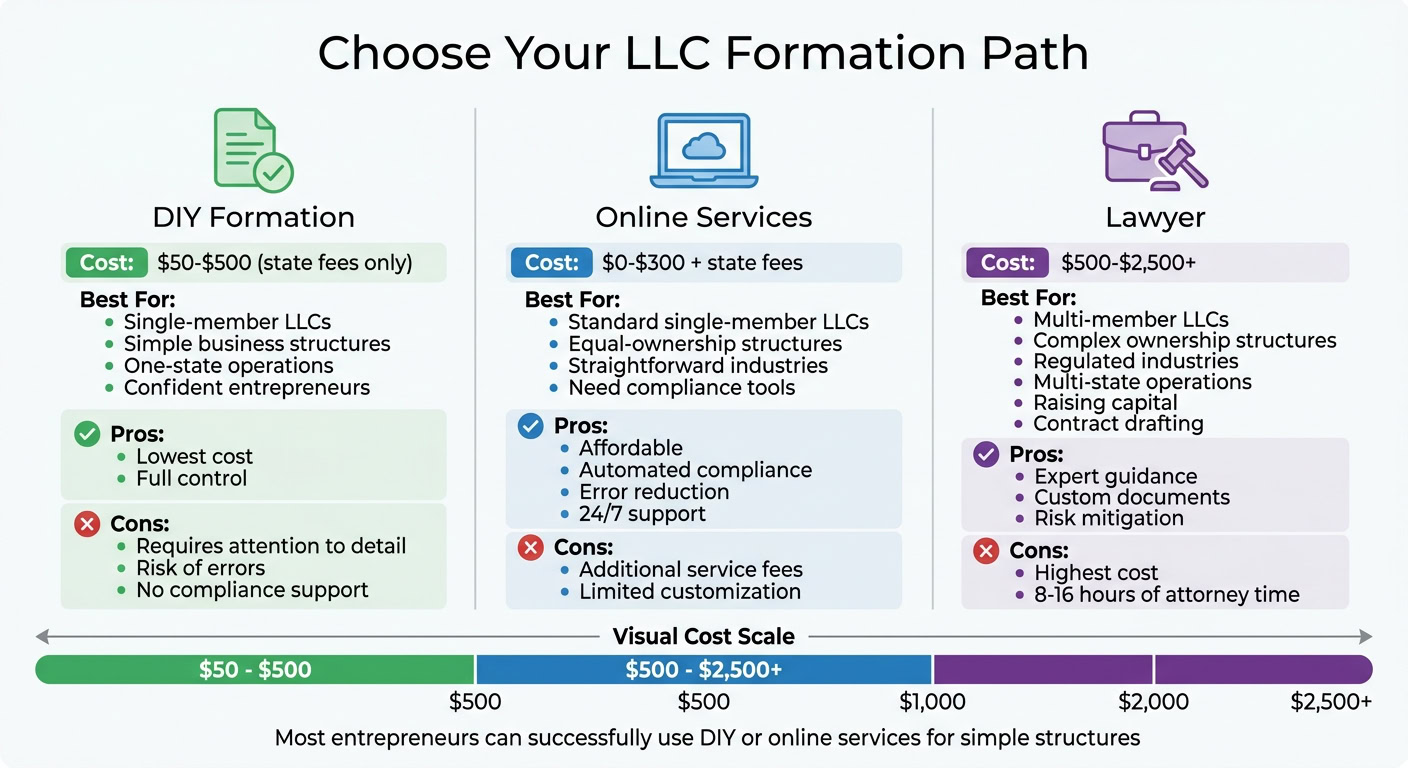
For simple businesses, you can handle the process yourself or use an online service for less money. Filing fees range from $50 to $500 depending on the state, and online services typically cost $0 to $300 plus state fees. Lawyers, on the other hand, charge $500 to $2,500 or more.
Here’s when to consider legal help:
- Complex ownership structures (e.g., multi-member LLCs)
- Regulated industries or multi-state operations
- Investor agreements or raising capital
- Drafting contracts or acquiring businesses
For single-member LLCs or straightforward setups, DIY or online services work well. Platforms like BusinessAnywhere offer $0 formation (plus state fees) and tools like free registered agent service for the first year.
Key takeaways:
- DIY is cheap but requires attention to detail.
- Online services simplify the process and are affordable.
- Hire a lawyer for complex setups to avoid mistakes.
Choose based on your business’s complexity, budget, and comfort with risk.
How LLC Formation Works
Setting up an LLC involves a series of steps that are mostly consistent across states, although the specific details and costs can vary. Knowing the process helps you decide whether to handle it yourself or seek legal help.
Steps to Set Up an LLC
The first step is choosing the state where you’ll register your LLC. Most people pick the state where their business operates, but some opt for states like Delaware or Wyoming for their business-friendly policies. Then, you’ll need to select a unique name that complies with state rules, typically requiring "LLC" or "Limited Liability Company" in the name.
Next, you’ll appoint a registered agent – this is someone with a physical address in the state who can receive legal documents on behalf of your LLC. This role can be filled by you, someone else, or a professional service. After that, you’ll file the Articles of Organization (sometimes called a Certificate of Formation), which officially establishes your LLC. This document will include your business name, address, and registered agent details.
Once your filing is approved, you’ll need to get an EIN (Employer Identification Number) from the IRS. This is free and necessary for opening business bank accounts or hiring employees. Another important step is drafting an Operating Agreement, which outlines ownership percentages, management roles, and profit-sharing rules. While only legally required in a few states like New York and California, having this document is critical for maintaining liability protection.
Filing fees and processing times vary widely by state. Here’s a quick comparison:
| State | Filing Fee | Processing Time |
|---|---|---|
| Texas | $300 | 2–3 business days |
| New York | $200 | 5–7 business days (+ publication costs) |
| Florida | $125 | 3–5 business days |
| Wyoming | $100 | Same day – 2 business days |
| Delaware | $110 | 3–5 business days |
| California | $70 | 5–7 business days |
Keep in mind that ongoing costs can also differ. For example, California imposes an $800 annual franchise tax, and New York requires additional publication fees.
Paying attention to details throughout the process is key to avoiding costly mistakes.
Common DIY LLC Formation Mistakes
Even with a straightforward process, many business owners make mistakes that can undermine the benefits of forming an LLC.
One of the biggest errors is mixing personal and business finances. If you use your business account for personal expenses – or vice versa – courts may "pierce the corporate veil", making you personally responsible for business debts. This defeats the purpose of an LLC entirely.
Another common issue is neglecting compliance. Most states require annual or biennial reports, with fees ranging from $0 to $300 depending on the state. Missing these deadlines or failing to pay franchise taxes can lead to your LLC being dissolved by the state, which removes your liability protection. With 5.5 million new business applications filed in 2023, state agencies are unlikely to send reminders – it’s up to you to stay on top of these requirements.
Many single-member LLC owners also skip creating an Operating Agreement, assuming it’s unnecessary for a one-person business. However, this document is crucial for reinforcing the separation between you and your business, which can protect you in case of a lawsuit. Since 85.8% of small businesses in the U.S. are run by solo entrepreneurs, this oversight affects millions.
To avoid these pitfalls, make sure to open a dedicated business bank account, draft an Operating Agreement, and set reminders for state filing deadlines. These simple steps can save you from costly legal headaches later on.
When You Don’t Need a Lawyer to Form an LLC
Most business owners can handle LLC formation without hiring a lawyer, especially if the business structure is straightforward and state requirements are followed carefully. For simple setups, DIY methods or online services often get the job done just fine. Let’s look at when a DIY approach works best and how BusinessAnywhere makes the process easier.
Best Situations for DIY or Online Services
If you’re forming a single-member LLC, the process is usually simple enough to handle on your own or through an online service. This is particularly true for service-based businesses like freelancing, consulting, or online retail. Things get even easier if your business operates in only one state, as you won’t have to deal with registering a foreign LLC in multiple jurisdictions. For straightforward single-member or multi-member LLCs, following the standard filing steps is often sufficient.
Cost is another factor to consider. A business attorney’s fees for forming an LLC can range from $500 to $2,500, which often includes a customized operating agreement. In contrast, online services typically cost between $0 and $300 plus state fees. Single-member LLCs can often rely on standard templates, while multi-member LLCs with more complex needs – like buyout provisions or dispute resolution clauses – might require the personalized attention an attorney provides, which can take anywhere from 8 to 16 hours.
How BusinessAnywhere Simplifies LLC Formation

For those opting for a DIY approach, BusinessAnywhere offers tools tailored to make LLC formation quick and hassle-free.
With BusinessAnywhere, you can form your business for $0 (plus state fees) through a streamlined online platform. This eliminates the need for in-person visits to government offices or navigating complicated state websites. The service also includes free registered agent service for the first year, ensuring your legal and tax documents are managed professionally while keeping your personal information private. After the first year, the registered agent service continues for $147 annually.
The platform provides customizable document templates, such as an Operating Agreement ($97) and a Banking Resolution ($27), so you can easily handle essential paperwork. They also offer an EIN application service for $97, though you can obtain an EIN for free directly from the IRS if you prefer.
Everything is managed online with clear, upfront pricing. You’ll have 24/7 access to your documents and compliance alerts via the dashboard, making it an excellent option for standard LLC formations – particularly for single-member LLCs or simple multi-member setups.
sbb-itb-ba0a4be
When You Should Hire a Lawyer
Some LLCs require the expertise of a lawyer to navigate their unique challenges. Factors like the complexity of your business structure, industry-specific regulations, and operational strategies can determine whether legal advice is necessary. Let’s explore scenarios where hiring a lawyer is a smart move and the risks of skipping professional help.
Complex Business Structures That Need Legal Help
If you’re forming a multi-member LLC, legal guidance can be crucial. When multiple owners are involved, it’s essential to establish clear agreements on profit sharing, decision-making, and exit strategies. Lawyers often spend 8–16 hours crafting custom operating agreements that address potential legal hurdles. This service typically costs several hundred to a few thousand dollars, depending on the complexity.
Businesses in regulated industries or operating across multiple states also benefit greatly from legal expertise. Industries like food service, construction, or finance face varying fees and licensing requirements, which an experienced attorney can help you navigate. If your business spans state lines, legal advice ensures compliance with differing state laws from the start.
Additionally, if you’re raising capital, hiring employees, acquiring another business, or drafting complex contracts, a lawyer can help minimize liability risks and protect your interests.
"Knowing when to hire a business attorney – and when you can safely go it alone – can save you thousands of dollars and countless headaches down the road." – Beancount.io
These examples highlight how legal expertise can safeguard your business from costly mistakes.
What Can Go Wrong Without a Lawyer
Skipping legal assistance in complicated situations can lead to serious problems – many of which can be expensive and time-consuming to fix.
One of the most common errors is trademark infringement. Entrepreneurs often check state name availability but overlook federal trademarks or unregistered "common law" trademarks. This oversight can result in lawsuits. A thorough search should include the U.S. Patent and Trademark Office (USPTO) database as well as social media platforms.
Another frequent issue involves contract disputes. Poorly written vendor or employment contracts are a leading source of litigation for small businesses.
"The cost of hiring an experienced lawyer to help out with more complicated situations will be more than offset by the costs you could incur if you make a mistake." – Amanda Hayes, Attorney
For simple LLCs, a DIY approach might work just fine. But when your business faces complexities like these, spending on legal advice now can save you from bigger expenses and headaches later.
How to Decide What’s Right for Your LLC
Once you’ve reviewed the formation process and key decision factors, it’s time to determine the best approach for setting up your LLC. Whether you choose to hire a lawyer, handle the filing yourself, or use an online service depends on how much you’re willing to spend, how complex your business needs are, and your comfort level with risk. While not every entrepreneur needs to pay hefty legal fees, certain business structures do benefit from professional assistance.
Checklist: Should You Hire a Lawyer or Use an Online Service?
Here’s a quick guide to help you decide:
- Hire a lawyer if your business involves unequal ownership splits, requires investor-ready documents like SAFEs or term sheets, or operates in a heavily regulated industry. Legal assistance typically costs between $500 and $3,000+ depending on your needs. While this is a larger upfront expense, it can save you from costly errors down the road.
- Use an online service if you’re forming a standard single-member or equal-ownership LLC, working in a straightforward industry, and want automated tools to help with compliance. These services usually charge between $110 and $949 for the first year, making them a more affordable option compared to hiring an attorney.
- Consider DIY filing if you’re confident in your ability to navigate the process and handle ongoing compliance requirements. In this case, you’ll only need to pay state filing fees, which generally range from $50 to $500.
For most straightforward LLCs, an online service that combines affordability with compliance tools will likely meet your needs.
Why BusinessAnywhere Works for Most LLC Formations
BusinessAnywhere provides a $0 LLC formation option (plus applicable state fees) and includes a free year of registered agent service when bundled. This approach keeps initial costs low while offering automated compliance reminders to help you stay on track with deadlines.
Their AI-guided system reduces filing errors, making the process smoother for those opting for a DIY approach. Other features include unlimited mail scanning via a virtual mailbox, remote online notary services at $37 per document, and essential document templates like operating agreements for $97. Everything is managed through a user-friendly dashboard available 24/7.
For LLCs that don’t require intricate investor agreements or complex multi-state compliance, BusinessAnywhere delivers the tools and support of pricier services at a clear and accessible price point.
Conclusion
Most entrepreneurs can set up an LLC without hiring a lawyer. For straightforward single-member or equal-ownership LLCs, you can handle the process yourself or use online services, which are far more affordable than attorney fees that typically range from $500 to $2,500. The real challenge is understanding your business’s complexity and your tolerance for risk.
Attorney Amanda Hayes points out an important consideration:
The cost of hiring an experienced lawyer to help out with more complicated situations will be more than offset by the costs you could incur if you make a mistake.
This is especially relevant for businesses with complex ownership structures, intellectual property concerns, multi-state operations, or strict regulatory requirements. In such cases, professional legal guidance can help you avoid costly errors.
For simpler setups, online formation services are a cost-effective choice. These services usually charge between $0 and $300, plus state fees, and provide essential tools for filing and compliance without unnecessary expenses. For example, BusinessAnywhere offers a $0 formation option (state fees apply) along with a free first year of registered agent service. Their platform ensures accurate filings, timely compliance reminders, and 24/7 dashboard access – all at a fraction of what hiring an attorney would cost.
FAQs
Do I Need a Lawyer to Start an LLC?
No, you generally do not need a lawyer to start an LLC. Many entrepreneurs successfully form LLCs on their own or through online formation services. However, if your business has multiple owners, investors, complex legal agreements, or operates in a regulated industry, consulting a lawyer may be beneficial.
When Should I Hire a Lawyer for LLC Formation?
You should consider hiring a lawyer if your LLC has a complex ownership structure, plans to raise capital, operates in multiple states, requires custom contracts, or is subject to industry-specific regulations. Legal guidance can help prevent costly mistakes and ensure your business is properly structured.
What Is the Most Affordable Way to Start an LLC?
The most affordable option is typically filing the LLC yourself and paying only the state filing fee. Alternatively, online LLC formation services can simplify the process at a relatively low cost, usually charging between $100 and $300 plus state fees. These services are often a good middle ground between DIY filing and hiring an attorney.