

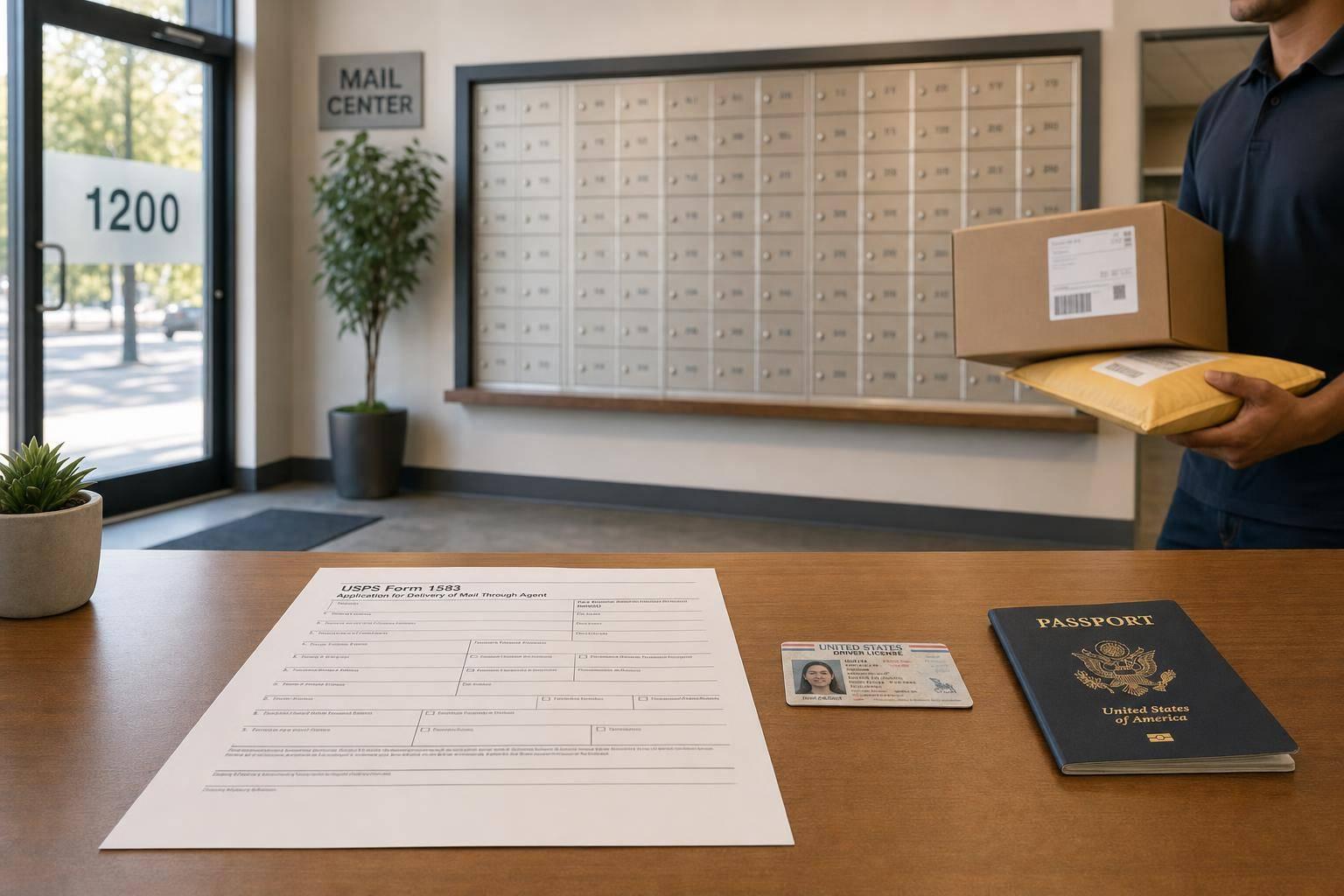
A CMRA is a private mail service that gives you a street address for business mail and packages. If you work from home, travel often, or run a U.S. business from abroad, it can help you keep your home address private while receiving mail from USPS, UPS, FedEx, and DHL.
Here’s the short version:
- A CMRA is not the same as a PO Box
- A CMRA is not the same as a registered agent
- You need USPS Form 1583 before a CMRA can accept your mail
- You must show 2 forms of ID
- Some banks and licensing offices may not accept a CMRA as your only address
- As of early 2025, about 12,000 CMRAs served around 1.6 million customers
If I had to sum it up in one line, it would be this: a CMRA works well for day-to-day mail, but it does not cover every business address need.
A PO Box, registered agent, and CMRA all serve different purposes. A PO Box is limited to USPS. A registered agent is for lawsuits, state notices, and other legal mail. A CMRA sits in the middle: you get a street-style mailing address, package handling, mail forwarding, and in many cases digital mail scans.
Here’s where people get mixed up:
- Need mail and packages from multiple carriers? Use a CMRA.
- Need legal notice handling for an LLC or corporation? Use a registered agent.
- Need a simple USPS-only mail option? Use a PO Box.
- Need licensing or banking approval? Check the rules first, because a CMRA may not be enough by itself.
A few points matter most before you sign up:
- Form 1583 is required
- Your name and address must match your ID records
- You may need to update IRS and business records after switching addresses
- Monthly CMRA pricing often falls around $10 to $50, while office space usually costs much more
If you want a private mailing address without paying for office rent, a CMRA can be a solid option. Just make sure you know its limits before you rely on it for banking, licensing, or legal compliance.
What a CMRA Is and How It Works
A Commercial Mail Receiving Agency (CMRA) is a USPS-authorized private business that receives mail and packages for customers at a street address. So instead of using a PO Box, you get a commercial address like 123 Main St, PMB 456. That matters because the address can accept deliveries from USPS, FedEx, UPS, and DHL.
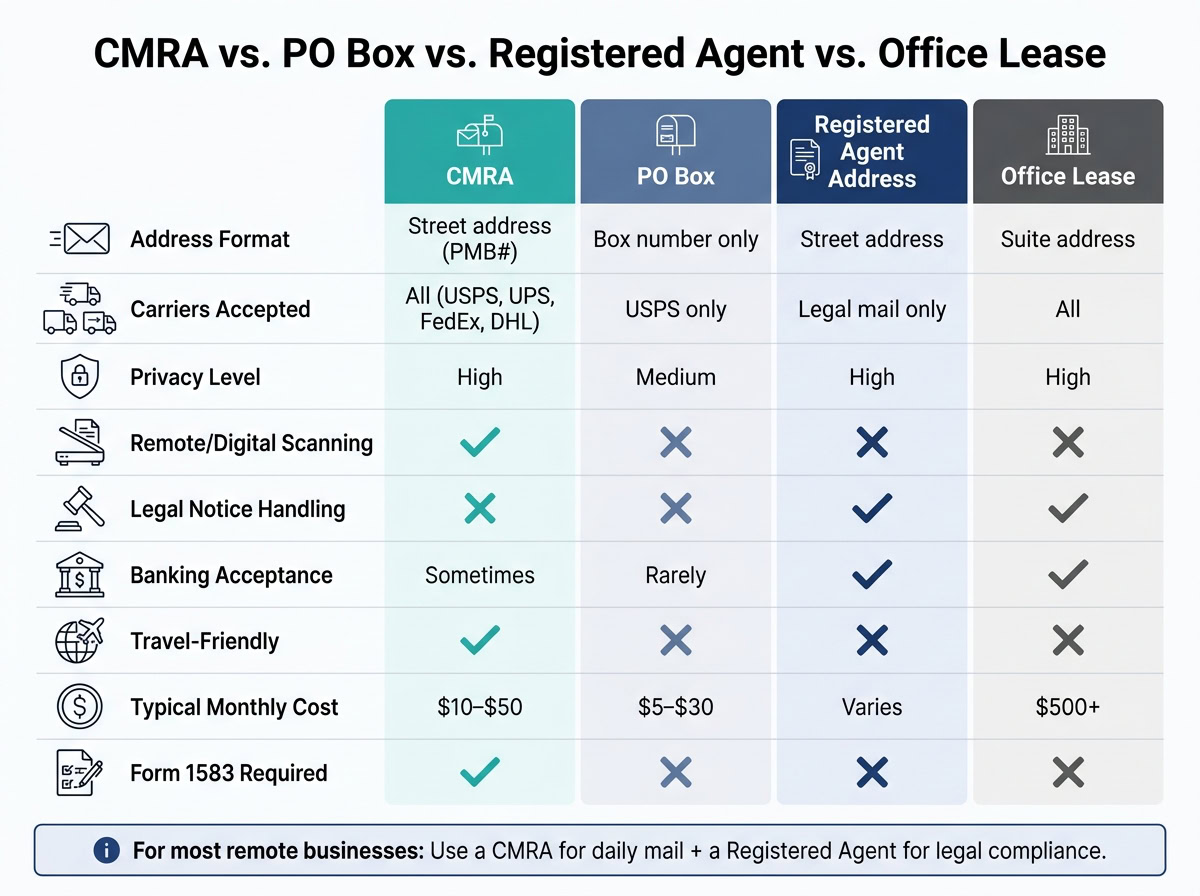
CMRA vs. PO Box vs. Registered Agent Address
These address types do different jobs. If you treat them like they’re the same thing, you can run into issues with banking, compliance, and daily business use.
| Feature | CMRA | USPS PO Box | Registered Agent Address |
|---|---|---|---|
| Address Type | Commercial street address | PO Box number | Physical street address |
| Carrier Support | All major carriers, including USPS, UPS, FedEx, and DHL | USPS only | Legal compliance and service of process |
| Primary Use | Business mail and package handling | Basic mail receipt | Legal notices and compliance |
| Public Exposure | Low | Moderate | High |
| Digital Access | Often includes scanning and online management | In-person pickup only | Usually none |
A PO Box comes straight from USPS, and it only accepts USPS mail. A registered agent address is for legal papers and government notices tied to an LLC or corporation. A CMRA sits right between those two. It gives your business a street address for everyday mail and package deliveries from more than one carrier.
That said, a CMRA isn’t always enough on its own. Some banks won’t accept a CMRA as the only business address. Others may flag or reject it during account review. It’s smart to check with your bank before putting a CMRA address on business accounts.
How Mail Moves Through a CMRA
The flow is simple. Mail and packages arrive at the CMRA’s physical location from any carrier. Staff log each item, then place it in your private mailbox (PMB) or add it to your digital queue. After that, you usually get an email or app alert, and in many cases you’ll see a scan of the envelope or package label.
From the online dashboard, you can usually choose what happens next:
- Request content scans
- Forward the item to another address
- Hold it for pickup
- Have it securely shredded
For remote business owners and digital nomads, that setup is a big help. You can stay on top of business mail without being in the same city – or even the same country.
Before a CMRA can receive mail for you, USPS requires identity verification through Form 1583.
USPS Rules, Form 1583, and Compliance Basics
USPS requires Form 1583 before a CMRA can receive mail for you. That form is what makes a CMRA a compliant mailing address.
What USPS Form 1583 Is and Why It Matters
PS Form 1583 is the USPS authorization form that allows a CMRA to receive mail for you. Every person or business that gets mail through a CMRA has to file it.
To fill out Form 1583, you need your legal name, home address, business name if you have one, and the CMRA’s delivery address. You’ll also need two forms of ID: one primary photo ID and one secondary ID that confirms your home address.
| ID Category | Acceptable Documents |
|---|---|
| Primary (Photo) | U.S. Passport or Passport Card, State Driver’s License, Military ID, Permanent Resident Card |
| Secondary (Address) | Current Lease or Mortgage, Utility Bill, Voter Registration Card, Vehicle Registration, Home or Vehicle Insurance Policy |
The name and address on Form 1583 must match your ID exactly. If they don’t, the form can be rejected. You must sign in front of the CMRA owner, an approved employee, or a U.S.-commissioned notary, either in person or by live video.
If both spouses want to receive mail at the same private mailbox (PMB), each person has to complete and sign a separate Form 1583. This requirement is one of the key differences when comparing virtual business addresses vs. PO Boxes.
This process is pretty straightforward: USPS uses it to verify who is tied to the address and to keep mail delivery legitimate.
What CMRAs Must Do to Stay Compliant
CMRA operators are governed by USPS Domestic Mail Manual Section 508.1.8. They must keep Form 1583 and ID records in the USPS Customer Registration Database (CRD). They also have to certify their customer records every quarter, with deadlines on January 15, April 15, July 15, and October 15.
If USPS finds a compliance gap, the CMRA gets 30 days to fix it. If that doesn’t happen, the Postal Service can suspend or terminate the CMRA’s authorization to accept mail for other people.
Before you use a provider, check the USPS CMRA registration list. Once the form is approved, the CMRA can start handling, scanning, and forwarding your mail.
Core CMRA Services for Businesses and Remote Owners
After Form 1583 approval, the CMRA can begin handling your mail.
Mail Handling, Package Acceptance, and Forwarding
Once USPS approval is in place, the CMRA can receive incoming mail and packages for you. Unlike a PO Box, a CMRA can accept deliveries from USPS, FedEx, UPS, and DHL. That makes it a better fit for business shipments, especially when you’re dealing with ecommerce orders, contracts, or time-sensitive documents.
Mail receipt is only part of the job. A CMRA also sorts mail, stores packages securely, and ships items to your current location. Forwarding is usually charged at standard carrier rates, plus a handling fee for each shipment. If something needs to move fast, you can request on-demand forwarding. If you’d rather bundle items together, you can set up scheduled shipments instead. That setup gives business owners a steady mailing address without having to stay in one place.
For remote owners, though, physical mail handling is only half the story. Digital access matters just as much.
Virtual Mailbox Access and Digital Scanning
When a letter or package comes in, staff scan the envelope or shipping label and send a notice to your online dashboard or mobile app. Then you decide what happens next: scan the contents, forward the item, shred it, or hold it.
That can make a big difference when you’re working on the go. An IRS notice, lease renewal, or bank statement doesn’t sit around waiting for a better time. With digital scanning, you can check what arrived and act on it without being in the same city – or even the same state.
This is the part that makes a CMRA click for remote owners: one mailbox, one dashboard, and mail access from almost anywhere.
How BusinessAnywhere Supports This Use Case

BusinessAnywhere’s virtual mailbox service brings together mail receipt, scanning, forwarding, and dashboard access for remote business owners. If you also need LLC formation, a registered agent, or an EIN application, you can manage your mail, formation, registered agent, and EIN services from one account.
sbb-itb-ba0a4be
When a CMRA Is the Right Choice for Your Business
A CMRA makes sense when you need one steady mailing address but you’re not tied to one place.
Best Use Cases: Privacy, Mobility, and Address Stability
A CMRA is a good fit if your business moves around, but your mail can’t.
- Home-based business owners: Use a CMRA to keep your home address off public filings.
- Digital nomads and frequent travelers: Use it to read, forward, and manage mail from anywhere.
- Expats running a U.S. company from abroad: Use it for a U.S. street address that accepts deliveries from major carriers.
For remote businesses, that means you get a mailing address that stays put, even when you don’t. It keeps business mail separate from your home or office, which can make day-to-day life a lot less messy.
Limits of a CMRA and When You Need More Than Mail Service
There’s a catch: a CMRA handles mail, but it doesn’t do everything.
A CMRA does not replace a registered agent. In most states, you still need a separate in-state address for legal notices.
Banking can also get tricky. Some banks may flag a CMRA address during account review. Before you sign up, ask the provider how their address shows up during banking checks.
Licensing is another spot where people get tripped up. Many municipalities want your actual operating location – your home or office – for licensing, zoning, and tax purposes, even if you use a CMRA for general mail.
And if you switch to a CMRA, don’t leave your tax records behind. Update IRS records, including Form 8822-B, so tax correspondence goes to the right place.
Comparison Table: CMRA vs. Home Address vs. PO Box vs. Office Lease
Here’s the fastest way to see the trade-offs side by side.
| Feature | CMRA | Home Address | PO Box | Office Lease |
|---|---|---|---|---|
| Privacy | High | Low (public record) | Medium | High |
| Street Address Format | Yes (street address with PMB/#) | Yes (residential) | No (box number) | Yes (suite) |
| Receives All Carriers | Yes (USPS, UPS, FedEx, DHL) | Yes | USPS only | Yes |
| Remote Scanning Access | Yes | No | No | No |
| Suitability for Compliance Mail | Limited (registered agent handled separately) | High | Low | High |
| Flexibility for Travel | High | Low | Low | Low |
| Typical Monthly Cost | $10–$50 | $0 | $5–$30 | $500+ |
For a remote-first business, a CMRA can be a low-cost way to handle mail without using your home address. Just don’t treat it like a full business address fix. You may still need a registered agent, and bank approval isn’t always a sure thing.
Conclusion: Key Points Before Choosing a CMRA
If you need a private, steady mailing address, use this checklist before picking a CMRA. A CMRA gives your business a street address for mail and package receipt.
Before a CMRA can accept mail for you, Form 1583 is required, along with two forms of ID. That step isn’t optional.
It also helps to choose an established provider so you’re less likely to deal with address changes later. And don’t mix up the roles: a CMRA handles mail, while a registered agent handles legal notices. Those are two separate jobs.
If your business is an LLC or corporation, make sure both are set up. BusinessAnywhere offers a virtual mailbox service and registered agent service to cover both. If a CMRA makes sense for your business, pick one that is stable, compliant, and simple to manage from anywhere.
FAQs
Can I use a CMRA to open a business bank account?
Yes, you can use a CMRA to open a business bank account, but it depends on the bank.
Some banks accept a CMRA address for business accounts. Others may turn it down or ask for extra paperwork before they approve the account.
Before you apply, check the bank’s address policy. If the account gets approved, make sure the bank has your business address on file correctly.
Do I still need a registered agent if I use a CMRA?
Yes. A CMRA can receive general business mail, packages, and admin correspondence. But it does not replace a registered agent.
A registered agent is your company’s official contact for legal and tax documents, including service of process. So while a CMRA can help keep your home address off public records, you still need to appoint a registered agent in your state of formation.
How long does Form 1583 approval usually take?
Form 1583 approval usually takes a few business days. In most cases, the timing comes down to how fast your provider finishes identity verification. The form itself is pretty short and usually takes about 15 minutes to complete.
If you want to avoid delays, have two valid IDs ready, including one photo ID. The form also needs to be notarized. Some providers can move things along by taking care of identity verification and notarization for you.