


When forming an LLC, one key decision is determining who will manage the business. There are two primary structures:
- Member-Managed LLC: Owners (members) handle daily operations and decision-making.
- Manager-Managed LLC: Members appoint managers (can be members or external individuals) to run the business while they focus on oversight.
Key Differences:
- Authority: In a member-managed LLC, all members can act on behalf of the business. Manager-managed LLCs restrict this authority to specific managers.
- Decision-Making: Member-managed LLCs involve all members in decisions. Manager-managed LLCs streamline this by centralizing control with managers.
- Best Fit: Member-managed is ideal for small, hands-on teams. Manager-managed works better for businesses with passive investors or large member groups.
Choosing the right structure depends on your LLC’s size, member involvement, and operational needs. This decision impacts daily operations, compliance, and how the LLC interacts with banks and third parties.
Understanding LLC Members
Who Are LLC Members?
LLC members are the owners of the business, holding what’s known as a "membership interest." This represents their equity stake in the company, functioning somewhat like shares in a corporation but with more flexible rules.
Membership is formalized through the Articles of Organization and the operating agreement. These documents outline each member’s rights and obligations. A detailed schedule, often labeled "Exhibit A", is attached to the operating agreement and lists members along with their contributions and ownership percentages.
It’s important to note that members don’t directly own the LLC’s assets. For example, if the LLC owns a building, no member has a personal claim to it. Instead, their ownership is in the LLC itself, not its individual property. Members can include individuals, other LLCs, corporations, or even foreign entities.
Next, let’s dive into the specific rights and responsibilities that come with being an LLC member.
Rights and Responsibilities of Members
Membership interest in an LLC includes two key components: an economic interest (the share of profits, losses, and distributions) and a management interest (voting rights and access to company records).
Members are typically involved in major decisions, such as amending the operating agreement, merging with another entity, or admitting new members. However, the extent of their involvement in daily operations depends on whether the LLC is member-managed or manager-managed.
Members also have fiduciary duties to the LLC. This means acting with loyalty by prioritizing the LLC’s interests and with care by making informed and sensible decisions.
In a member-managed LLC, every member is considered an agent of the company, giving them the authority to enter into contracts and legally bind the LLC. While this is a significant responsibility, it also introduces potential risks if a member exceeds their authority.
"Distributions are most common; they occur when a multi-member LLC’s profits are passed through to its members based on the ownership percentages or profit-sharing stipulations outlined in an entity’s operating agreement." – Thomas J. Brock, CFA, CPA
These rights and duties carry real-world implications for anyone thinking about becoming an LLC member.
What Members Should Know Before Joining an LLC
Before committing to LLC membership, it’s essential to understand both your rights and the practical challenges involved.
Liability protection isn’t automatic. The LLC’s liability shield only works if the business is treated as a separate legal entity. This means protecting your personal assets by keeping personal and business finances separate, maintaining accurate records, and signing documents properly – for instance, as "Jane Doe, Member, XYZ LLC".
Exiting can be complicated. Many operating agreements limit voluntary withdrawal. In most cases, you can’t simply leave and cash out your membership interest without the approval of other members. It’s crucial to review the buy-sell provisions beforehand, as they dictate what happens to your interest if you decide to leave, become incapacitated, or pass away.
Taxes may surprise you. In multi-member LLCs, profits and losses pass through to members’ personal tax returns. This means you could owe taxes on profits even if they haven’t been distributed – a common issue for new members.
The operating agreement is the backbone of these arrangements. It determines ownership percentages, voting rights, profit distribution, and exit rules. Without a detailed agreement, state default rules apply, which often don’t align with members’ expectations.
sbb-itb-ba0a4be
Understanding LLC Managers
Who Are LLC Managers?
In an LLC, members are the owners with key rights, but managers take charge of the day-to-day operations. These managers can be individuals or entities authorized to handle the LLC’s routine activities and represent it legally. They might come from within the membership or be external professionals, depending on the needs of the business.
Managers can be structured in different ways, as Nolo explains:
"The management team may be made up of: some, but not all, LLC members; both outside managers and some LLC members, or only outside managers."
This flexibility is particularly appealing to businesses that want to bring in experienced professionals to manage operations without giving them ownership stakes. It’s a practical way for growing businesses to balance expertise with ownership control.
Responsibilities and Authority of Managers
Managers in an LLC wield significant authority. They handle contracts, oversee financial transactions, manage employees, and make the decisions that keep the business running smoothly. One of their most critical roles is having binding authority, which means their actions can legally commit the LLC.
"Each manager has legal authority to bind the LLC to contracts and business deals made with outsiders."
This authority sets managers apart from members in a manager-managed LLC. Passive members typically cannot enter into contracts on behalf of the business unless explicitly authorized. Alongside operational duties, managers also have fiduciary responsibilities, which include:
- Duty of loyalty: Avoiding self-dealing or hidden conflicts of interest.
- Duty of care: Making informed and reasonable decisions.
- Duty of good faith and fair dealing: Acting in the best interest of the LLC.
While managers generally aren’t personally liable for the LLC’s debts, there are exceptions. If a manager engages in illegal acts, gross negligence, or self-dealing, they could face personal liability.
Understanding these responsibilities is key to grasping how a manager-managed LLC operates. With this groundwork, we can look at how these structures function in everyday business.
How Manager-Managed LLCs Work
In a manager-managed LLC, members take a step back from daily operations, assuming a more passive role akin to investors. They still own a stake in the business and receive distributions, but their voting rights are typically reserved for major decisions, such as:
- Amending the operating agreement
- Adding new members
- Dissolving the company
For this structure to be legally recognized, most states require it to be explicitly stated in the Articles of Organization filed with the state. Additionally, the operating agreement should define the manager’s specific powers and any limitations. Some states, like Nevada, Idaho, and Washington, even require managers to be named in public filings to formalize their authority.
Here’s a quick breakdown of common management setups and their typical applications:
| Structure | Who Manages | Use Case |
|---|---|---|
| Manager-Managed (Internal) | Select members only | LLCs with passive investor members |
| Manager-Managed (External) | Outside professionals | LLCs needing specialized management expertise |
| Manager-Managed (Hybrid) | Members + outside managers | Growing companies blending owner and professional oversight |
If the LLC plans to hire external managers, it’s wise to include an indemnification clause in the operating agreement. This clause helps protect managers from personal legal expenses related to their duties, making the role more attractive to qualified professionals.
Member-Managed vs. Manager-Managed LLCs: A Direct Comparison
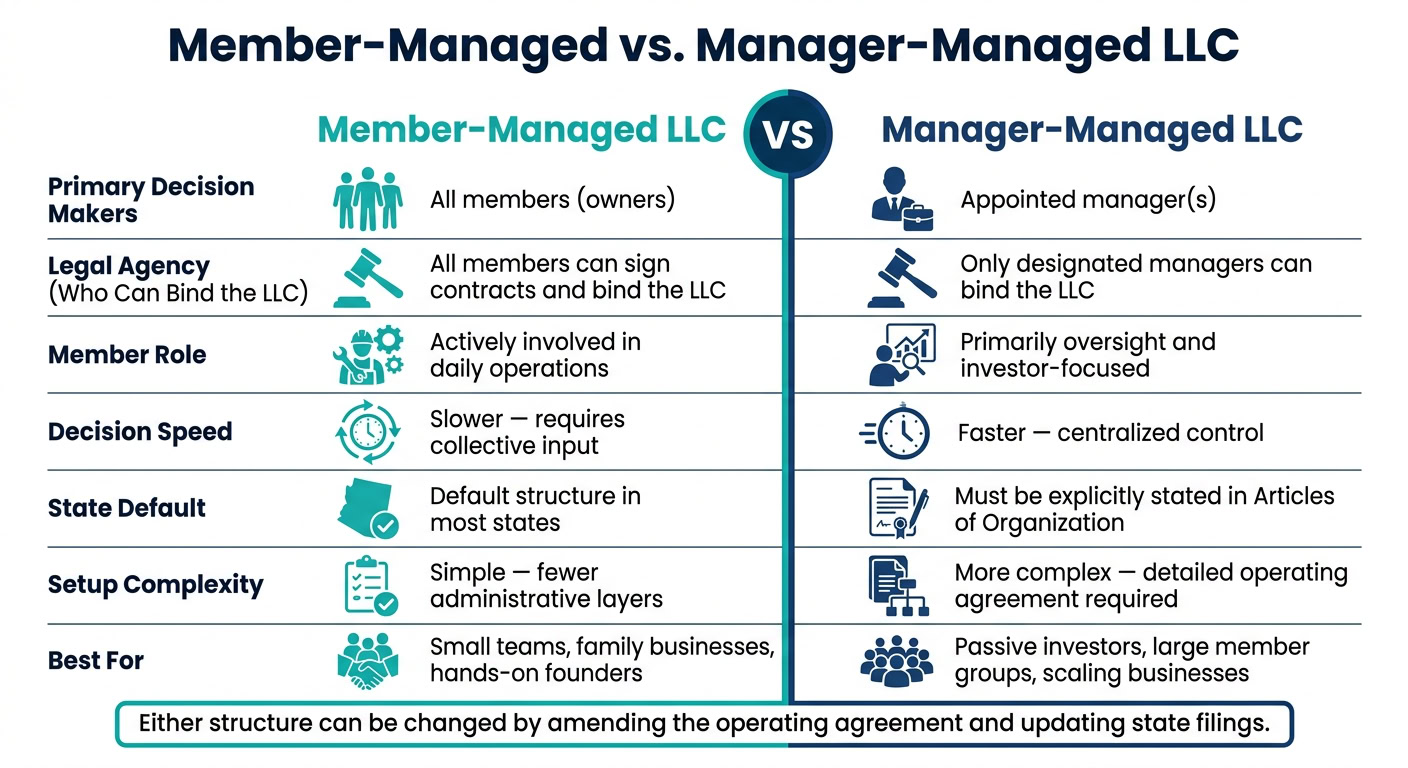
When deciding between a member-managed or manager-managed LLC, everything boils down to authority – who has the legal power to make decisions, sign contracts, and handle day-to-day operations.
Differences in Roles and Authority
In a member-managed LLC, every member (or owner) has the authority to act on behalf of the business. In contrast, a manager-managed LLC limits this power to specific managers. This distinction is more important than many realize. Vendors, banks, and other third parties need clarity on who is authorized to sign contracts. If the wrong person signs, it can lead to legal headaches for the business.
Here’s a quick comparison of the two structures:
| Feature | Member-Managed LLC | Manager-Managed LLC |
|---|---|---|
| Primary Decision Makers | All members (owners) | Appointed manager(s) |
| Legal Agency | All members can bind the LLC | Only managers can bind the LLC |
| Member Role | Actively involved in operations | Primarily oversight-focused |
| Decision Speed | Slower due to collective decision-making | Faster with centralized control |
| State Default | Default structure in most states | Must be specified in filings |
| Best For | Small groups, family businesses | Passive investors, larger teams |
In a manager-managed LLC, tasks like hiring, signing contracts, or opening bank accounts fall solely to the appointed manager. Members in this setup only vote on major issues, such as selling the business or amending the operating agreement.
Pros and Cons of Each Structure
Weighing the benefits and drawbacks of each structure is essential. Sandra Feldman, Publications Attorney at Wolters Kluwer, emphasizes:
"Deciding how their LLC will be managed is one of the most important decisions members will make before forming the company."
Here’s a breakdown of the pros and cons:
| Structure | Pros | Cons |
|---|---|---|
| Member-Managed | Easy to set up; keeps all owners informed; no external management needed | Slower decision-making; requires full member involvement |
| Manager-Managed | Streamlined decisions; ideal for passive investors; better for scaling | More complex setup; less transparency for members on daily operations |
How to Choose the Right Structure for Your LLC
The decision ultimately comes down to three factors: how many members are involved, how active they want to be, and the long-term goals of the business.
For small LLCs where all members are hands-on – like a family shop or a two-person consulting firm – a member-managed structure is often the logical choice. Everyone is already engaged, so adding a formal management layer would be unnecessary.
"A member-managed LLC is often a good fit for LLCs with fewer members, especially when each member wishes to play an active role in the day-to-day affairs of the business." – Kristin Kreuder, Author, Outside GC
On the other hand, manager-managed LLCs work well for businesses with passive investors, numerous members, or owners who lack the expertise to handle operations. For example, a real estate investment LLC with 12 members in different states would benefit from centralized decision-making to keep things efficient.
"If your LLC has so many members that decision making has become too complex or divisive, it may make sense to designate a smaller subset of your members as managers." – TRUiC Team
The good news? This decision isn’t set in stone. If your business grows or changes, you can amend the operating agreement and update state filings to switch structures. This flexibility ensures your LLC can adapt as needed. Understanding these distinctions helps clarify how management structure shapes operations and compliance. Next, we’ll dive deeper into how these choices impact day-to-day business and regulatory requirements.
How Your Management Structure Affects Compliance and Daily Operations
The management structure you choose for your LLC isn’t just an internal matter – it has a direct impact on how your business operates and interacts with banks, state agencies, and third parties.
Drafting the Operating Agreement
Your operating agreement is where your management structure is clearly defined and formalized. This document must outline authority limits, decision-making processes, and voting thresholds. The goal is to avoid ambiguity that could lead to internal disputes.
For example, the agreement should differentiate between routine decisions and major actions – like mergers, taking on significant debt, or selling major assets – by specifying the exact voting requirements for each scenario. In a manager-managed LLC, it’s also important to detail how managers can be removed, whether through a majority vote or for specific causes.
If a member doubles as a manager, the agreement should include provisions for disclosing conflicts of interest. This could mean requiring them to step back from votes where they have a personal stake.
Drafting for a manager-managed LLC often involves more upfront effort. As Kristin Kreuder from Outside GC explains:
"Choosing this [manager-managed] structure may be more costly up front in terms of the drafting of the management provisions within the operating agreement."
Once the operating agreement is in place, the next step is updating your public records to reflect these decisions.
State Filings and Documentation
In many states, such as California and Iowa, LLCs are member-managed by default unless otherwise stated in the Articles of Organization. If you prefer a manager-managed setup, this must be explicitly noted in your formation documents.
State filings act as public notice of who has authority to act on behalf of your LLC. If your filings conflict with your operating agreement, you risk confusing vendors, lenders, or anyone else trying to verify who has decision-making power.
If your LLC transitions from member-managed to manager-managed as it grows, you’ll need to amend both your operating agreement and state filings to reflect the change. Failing to do so can leave your public records outdated, which could lead to legal complications.
Banking, Taxes, and Recordkeeping
Your management structure also affects your financial operations and compliance requirements. For instance, only designated managers can sign checks or authorize transactions for your LLC’s bank accounts. Banks will typically require a copy of your operating agreement to confirm who has signing authority. In a manager-managed LLC, this document verifies that non-managing members cannot act as agents of the business.
"In a manager-managed LLC, members are not considered ‘agents’ of the business, and generally do not have the authority to bind the company." – Kristin Kreuder, Author, Outside GC
On the tax side, if your LLC opts for S-corp status, the IRS requires reasonable salaries for corporate officers. In a member-managed LLC, this applies to all actively involved members. In a manager-managed LLC, it specifically applies to the managing members. Missteps here could draw unwanted IRS attention.
For recordkeeping, manager-managed LLCs – especially those involving outside investors or lenders – are often required to maintain separate bank accounts, financial statements, and records. This not only ensures compliance but also preserves the LLC’s legal separateness. These practices are often outlined in the operating agreement and may even be contractually required.
Conclusion
In an LLC, the roles are distinct: members own the business, while managers oversee daily operations. In a member-managed structure, all owners are involved in decision-making. On the other hand, a manager-managed setup delegates authority to specific individuals, which can streamline operations for larger or more complex ownership groups.
The importance of this decision can’t be overstated. Sandra Feldman, Publications Attorney at Wolters Kluwer, emphasizes its significance:
"Deciding how their LLC will be managed is one of the most important decisions members will make before forming the company."
Choosing the right structure depends on your specific needs. A small team of active founders often leans toward a member-managed model for its straightforward nature and fewer administrative layers. However, if your LLC includes passive investors or members lacking operational expertise, a manager-managed structure can ensure smoother, more centralized management.
What’s reassuring is that this choice isn’t permanent. As Kristin Kreuder of Outside GC explains:
"As the nature, size and investment structure of your company may change over time, so too can your management structure by simply modifying your operating agreement to suit the current needs of your entity."
Regardless of the structure you choose, having a well-drafted operating agreement is critical. It clarifies decision-making authority and lays the groundwork for your LLC’s success.
FAQs
Can an LLC have both members and managers?
In an LLC, it’s possible to have both members and managers. In a manager-managed LLC, members can take on the role of managers, or the LLC can choose to appoint specific managers who aren’t members. The exact structure is determined by the LLC’s setup and outlined in its operating agreement.
How do I switch from member-managed to manager-managed?
To change an LLC from member-managed to manager-managed, here’s what you need to do:
- Hold a vote among members: Follow the process detailed in your operating agreement or state laws to get approval for the change.
- Revise the Operating Agreement: Update it to reflect the new management structure and specify the designated managers.
- File amendments with the state: Submit necessary updates, like changes to the Articles of Organization, as required by your state.
- Notify relevant authorities and update records: Ensure all internal and external records align with the new structure to stay compliant.
What should an operating agreement say about signing authority?
An operating agreement needs to spell out who holds signing authority – whether it’s the members or the managers. It should also detail the extent of their authority and lay down clear procedures for approving and documenting any signatures made on the LLC’s behalf. This approach helps maintain transparency and ensures the company stays in compliance with its operational guidelines.