
If you want to operate your business under a name different from its legal name in Michigan, you must register a DBA (Doing Business As), also called an "assumed name." Here’s how the process works:
- Who Needs to File?
- Sole proprietors and general partnerships file at the county level where they operate.
- LLCs, corporations, and limited partnerships file at the state level through Michigan’s Department of Licensing and Regulatory Affairs (LARA).
- Steps to File:
- Check Name Availability: Ensure your chosen name isn’t already taken by checking county or state databases.
- Complete the Forms: Sole proprietors/partnerships need a county-specific form. LLCs/corporations submit a "Certificate of Assumed Name" to LARA.
- Submit and Pay Fees:
- County-level fees: $6–$22.
- State-level fees: $10–$25.
- Validity and Renewal:
- DBAs are valid for five years and must be renewed to remain active.
Filing a DBA is essential for compliance, opening business bank accounts, and signing contracts under your chosen name. Keep your records updated and renew promptly to avoid losing your assumed name.
Michigan DBA Basics and Legal Requirements
What Is a DBA in Michigan?
In Michigan, the term "DBA" (Doing Business As) is commonly used, but the state officially refers to it as an assumed name. Both terms essentially mean the same thing – operating a business under a name that’s different from the legal name of the person or entity that owns it.
It’s important to note that filing an assumed name does not create a separate legal entity. Here’s what Michigan law says about it:
"A person shall not carry on, conduct, or transact business in this state under an assumed name… unless the person files… a certificate on a form furnished by the county clerk." – Michigan Compiled Laws Section 445.1
If you skip this step, you could face fines, run into trouble enforcing contracts in court, or encounter issues when trying to open a business bank account. So, registering your assumed name isn’t just a formality – it’s a legal necessity.
Now, let’s look at who needs to file and how the process works.
Who Needs to File a DBA?
If you’re running a business under a name that isn’t your legal name, you need to register it. Here’s how it breaks down:
- Sole proprietors typically operate using their full personal names.
- LLCs and corporations use the name they registered with the state.
If you plan to use a different name, you’ll need to file an assumed name certificate. The filing location and fees depend on your business structure: Business Type Filing Location Fee
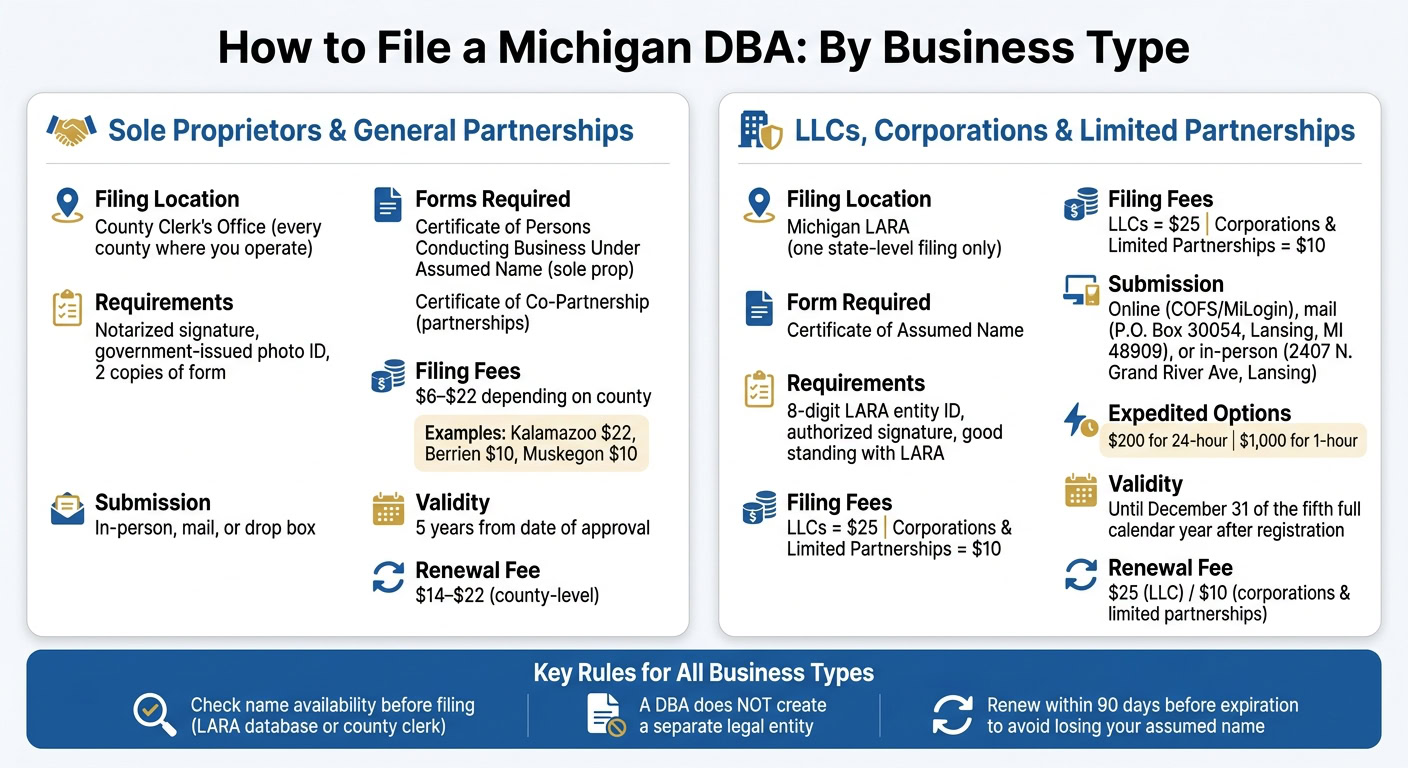
If you’re a sole proprietor or part of a general partnership, you’ll need to file in every county where your business operates. On the other hand, LLCs and corporations only need to file once at the state level through LARA.
There are a couple of exceptions to keep in mind:
- Businesses that sell exclusively through traveling agents, mail order, or samples don’t need to file.
- Insurance agents or agencies must register their assumed names with the Department of Insurance and Financial Services instead of LARA or the county clerk.
Once registered, an assumed name in Michigan is valid for five years, after which it must be renewed to stay active.
Naming Rules for Michigan Assumed Names
Choosing the right name for your business is more than just a branding decision – it also needs to comply with Michigan’s rules. Here’s what you need to know:
- Avoid misleading entity identifiers: If you’re a sole proprietorship, your assumed name can’t include terms like "LLC" or "Inc."
- Restricted words require approval: Words such as "bank" or "insurance" may only be used if you have the appropriate licensing or regulatory permissions.
- No confusingly similar names: Your assumed name must be distinct from any existing business or assumed name already registered with LARA or the county clerk.
To check if your desired name is available, you can use the LARA Business Entity database or visit the county clerk’s office. It’s also a good idea to search the USPTO trademark database to ensure your name doesn’t conflict with a federally registered trademark.
How Sole Proprietors and Partnerships File a DBA
If you’re running a sole proprietorship or general partnership, registering a DBA (Doing Business As) happens at the county level – not the state level. This means you’ll need to file with the county clerk’s office in every county where you operate your business.
Step 1: Check Name Availability
Before filing any paperwork, make sure the name you want to use is available. Start by checking with the county clerk’s office in the county where you plan to do business. Some counties have online search tools, while others might require you to call or visit in person. For example, the Kalamazoo County Clerk’s Office explains:
"The Kalamazoo County Clerk’s Office is required to ensure that the business name you are seeking is not being used as an Assumed Name or Co-Partnership within Kalamazoo County." (Kalamazoo County Clerk’s Office)
You should also check for potential conflicts using the LARA Business Entity Search and the LARA Marks & Insignia database for state trademarks. To avoid federal trademark issues, search the USPTO’s Trademark Electronic Search System (TESS). Keep in mind that a county-level DBA only protects your name within that specific county. If your business spans multiple counties, you’ll need to file in each one.
Once you’re sure the name is available, you can move on to completing the required forms.
Step 2: Complete the Necessary Forms
The forms you need depend on your business structure:
- Sole proprietors file a Certificate of Persons Conducting Business Under Assumed Name.
- Partnerships file a Certificate of Co-Partnership.
These forms are available from your county clerk’s office and will ask for:
- The assumed name you’re registering
- The full legal names of all owners or operators
- The residence or principal business address of each individual
You’ll need a valid government-issued photo ID, and the form must be signed in the presence of a Notary Public. Many county clerk offices offer notary services on-site, making it convenient to complete everything in one visit. For partnerships, all partners must sign the document.
With your forms completed and notarized, you’re ready for the next step.
Step 3: File with the County Clerk
Submit your notarized forms to the county clerk’s office. You’ll need to provide two copies – one for the clerk to keep and one that will be returned to you as a certified copy. Filing fees vary by county, as shown below:
| County | Filing Fee | Submission Methods |
|---|---|---|
| Kalamazoo | $22.00 | Mail, in-person, drop box |
| Berrien | $10.00 | In-person (St. Joseph or Niles offices) |
| Muskegon | $10.00 | Mail, in-person |
| Statutory Minimum (MCL) | $6.00 | County clerk’s office |
If you’re filing by mail, include a stamped, self-addressed envelope so the clerk can return your certified copy. Payment methods differ by county, so it’s best to call ahead and confirm if they accept checks, money orders, or credit cards.
Once filed, your DBA registration will be valid for five years from the date of approval.
How LLCs and Corporations File a DBA
Unlike sole proprietors and partnerships, registered business entities like LLCs, corporations, limited partnerships, and nonprofits handle their assumed name filings at the state level through the Michigan Department of Licensing and Regulatory Affairs (LARA). The process is straightforward and often completed online. To start, confirm your entity’s status and check name availability using LARA’s resources.
Step 1: Confirm Entity Status and Name Availability
First, ensure your business is in good standing with LARA. If your entity has overdue annual reports or unpaid fees, LARA will not process your filing. You can check your status using the LARA Business Entity Search tool. Even if you’ve done a name check at the county level, state-level filing requires separate verification.
Next, use the same LARA database to confirm that your desired assumed name is available. The name must be distinguishable from all other registered legal and assumed names in Michigan. Additionally, check the LARA Marks & Insignia Search to avoid conflicts with state trademarks. Keep in mind, the assumed name cannot include entity identifiers that don’t align with your structure – for instance, a corporation can’t use “LLC” in its DBA. It’s also a good idea to verify domain name availability to align with your new name.
Step 2: Fill Out the Certificate of Assumed Name
To file your DBA, you’ll need the Certificate of Assumed Name. Prepare the following information:
- Your LARA-registered legal name
- Your 8-digit LARA entity ID number (found in your formation documents or through the LARA search)
- The assumed name you want to register
- A mailing address for LARA to send your completed certificate (if left blank, it defaults to your registered agent’s address)
- The signature of an authorized person – this could be a member/manager for an LLC or an officer for a corporation
If you’re part of a joint venture, each participating entity must file its own certificate, including all relevant names and ID numbers.
Step 3: Submit the Filing to LARA
You can submit your Certificate of Assumed Name using one of three methods:
| Submission Method | Details | Accepted Payments |
|---|---|---|
| Online | Through the LARA Corporations Online Filing System (COFS) via MiLogin for Business | Credit/debit card |
| By Mail | Send to P.O. Box 30054, Lansing, MI 48909 | Check or money order |
| In Person | Visit 2407 N. Grand River Ave, Lansing, MI 48906 | Cash, check, or card |
Online filing via MiLogin is the quickest option. The fees are $25 for LLCs and $10 for corporations and limited partnerships. Expedited processing is available for an additional cost: $200 for 24-hour service or $1,000 for 1-hour service .
Once filed, your assumed name remains valid until December 31 of the fifth full calendar year after the year of registration. For instance, if you file in 2026, your DBA will expire on December 31, 2031. Be sure to renew within 90 days before expiration to avoid issues. The renewal fee is the same as the original filing fee. Staying on top of this ensures compliance with Michigan regulations and keeps your business operating smoothly.
sbb-itb-ba0a4be
Keeping Your Michigan DBA in Good Standing
Maintaining a Michigan DBA (Doing Business As) requires timely renewal, proper use in business operations, and making updates when necessary.
Renewing Your DBA
In Michigan, a DBA is valid for five years, and the renewal process mirrors the original filing. Sole proprietors and partnerships renew through the county clerk’s office, while LLCs and corporations handle renewals via LARA (the Michigan Department of Licensing and Regulatory Affairs). Renewal fees vary:
- County-level fees: Typically range from $14 to $22, depending on the county.
- State-level fees: $25 for LLCs and $10 for corporations and limited partnerships.
It’s crucial to keep your address on file up to date. If it’s outdated, you might miss the renewal notice sent by the clerk 30 to 60 days before your DBA expires. Missing the renewal deadline means your assumed name will be considered abandoned under Michigan law.
"The certificate when acknowledged and filed as required in section 1 shall authorize use of the assumed name for 5 years." – Michigan Compiled Laws Section 445.1a
Once renewed, your DBA remains valid for conducting business as usual.
Using Your DBA for Business Operations
An active DBA allows you to open a business bank account, sign contracts, and market your business under the assumed name. Most banks require a filed assumed name certificate to open an account under any name other than the legal name of the owner.
When signing contracts, always include both your legal name and DBA. For example: "James Carter, doing business as Carter Creative Co." Using only the DBA may make the contract unenforceable.
After your DBA is established, it’s essential to update or cancel the filing if your business details change.
Updating or Canceling Your DBA
If your business address or ownership changes, file an update with the appropriate office immediately – don’t wait until the next renewal. County-level updates typically cost around $10 and cover changes such as a new address or ownership adjustments. For LLCs and corporations, state-level updates follow the same fee structure as the original filing.
If you need to cancel your DBA, the required form depends on your location. For instance:
- Kent County uses a "Notice of Dissolution Form."
- Oakland County uses a "Certificate of Discontinuance."
For state-registered entities, cancellations are done through LARA’s online system by filing a Certificate of Termination of Assumed Name. Cancellation fees are:
- County-level: $5 to $10, depending on the county.
- State-level: $25 for LLCs and $10 for corporations and limited partnerships.
Conclusion
Filing a DBA in Michigan involves specific steps based on your business structure. Sole proprietors and general partnerships must register their DBA with the County Clerk in every county where they operate. On the other hand, LLCs, corporations, and limited partnerships handle their filings at the state level through LARA. The filing fees are straightforward: county filings range from $10 to $16, LLCs pay $25, and corporations pay $10.
It’s important to note that a DBA serves as a branding tool, not a legal shield. As Forbes Advisor contributor Toni Matthews-El puts it, "A DBA is more or less a branding identity, while an LLC is a legal business entity". Your legal name remains the one used for tax filings, liability issues, and formal documents.
DBA registrations in Michigan are valid for five years, so keeping track of renewal deadlines is crucial to avoid losing your assumed name. Set reminders for the expiration date and update your records promptly if your address or business ownership changes. This ensures you’ll receive renewal notifications without issue.
Following the outlined steps ensures compliance with all filing requirements, whether at the county or state level. An active DBA allows you to open bank accounts, sign contracts, and build your brand effectively. For contracts, always include both your legal name and DBA, such as "Legal Name, doing business as Assumed Name", to ensure enforceability.
FAQs
Do I need to file a DBA in every Michigan county?
Yes, you need to file a DBA (Doing Business As) in every county where your business operates or has an office. Unlike state-level registrations, a county-level DBA is only valid within the specific county where it’s filed. For sole proprietorships and partnerships, registration must be completed with the county clerk. On the other hand, corporations and LLCs handle their assumed name filings at the state level through the Department of Licensing and Regulatory Affairs.
Does a Michigan DBA protect my personal assets?
No, a Michigan DBA doesn’t safeguard your personal assets. It simply lets you do business under a different name but doesn’t establish a separate legal entity. If you’re operating as a sole proprietorship or general partnership, you’re still personally responsible for any business debts. To shield your personal assets, you might want to think about setting up a separate entity, like an LLC.
Can I use my Michigan DBA name as my domain and brand?
Yes, you can use your Michigan DBA as both your brand and domain name. Many businesses choose to register a DBA to align their legal name with their branding or online presence. However, keep in mind that registering a DBA doesn’t automatically ensure the name is available as a trademark or domain. To avoid potential conflicts, it’s a good idea to search the LARA database and check domain registries before finalizing your decision.