

Series LLCs provide a unique structure for businesses, offering liability protection between individual “series” under one master LLC. But here’s the catch: not all states recognize or enforce this structure uniformly. If you operate across multiple states, this could expose you to unexpected risks.
- Key takeaway: The liability shield works only if strict legal formalities are followed, including separate records, bank accounts, and governance for each series.
- State-by-state differences: Some states like Delaware and Illinois enforce strong protections, while others like California and New York disregard them entirely.
- Compliance matters: Poor record-keeping or commingling assets between series often leads courts to treat the entire LLC as a single entity.
Understanding how your state treats Series LLCs is critical to protecting your personal assets and avoiding legal pitfalls. The article breaks down state-specific rules, common mistakes that lead to litigation, and practical steps to maintain compliance.
How Series LLCs Can Fail in Court
The internal liability shield of a Series LLC only works if you follow the required formalities. Courts often disregard the separation between series when they find poor record-keeping or violations of statutory requirements. From 2023 to 2025, litigation and bankruptcy cases have shown increased skepticism toward Series LLCs. Below are key situations where courts break down this liability protection.
“Formalities decide fate.” – Brian T. Bradley, Asset Protection Attorney
When Courts Pierce the Liability Shield
One of the biggest red flags for courts is commingling of assets and funds. When bank accounts or assets are shared between series, courts may treat the entire Series LLC as a single entity. Another common issue is insufficient capitalization – if a series doesn’t have enough capital to cover its expected liabilities, courts might see this as an attempt to defraud creditors and remove liability protections.
In bankruptcy cases, trustees frequently try to consolidate all series into one estate, especially when the Series LLC cannot demonstrate that each series operates independently. Courts now expect each series to maintain separate Tax IDs and tax elections, governance structures, and bank accounts to be recognized as distinct debtors. In states like California, New York, and Washington, courts may dismiss internal liability shields entirely based on public policy, treating the Series LLC as a single traditional LLC regardless of the laws in its formation state. Knowing these risks is crucial for managing state-specific litigation challenges.
Documentation and Compliance Failures
Beyond court battles, proper record-keeping and documentation are just as important. States like Nevada (NRS 86.296) and Illinois require each series to keep “separate and distinct records” for its assets and liabilities. Failing to meet this requirement can result in the liabilities of one series becoming the liabilities of the entire LLC – even without a court piercing the corporate veil. For example, paying a Series A expense from Series B’s bank account signals legal intermingling.
Incorrectly titling assets also voids protections. Assets must be titled in the name of the specific series, such as “ABC Holdings, LLC, Protected Series A”, rather than the master LLC. The same applies to contracts – leases, vendor agreements, and loans must be signed under the specific series involved. Signing under the master LLC can expose the entire entity to the liabilities of that contract. In states like Florida, the Articles of Organization must explicitly authorize the creation of protected series. Without this statutory notice, the liability shields have no legal standing.
sbb-itb-ba0a4be
How Each State Treats Series LLCs in Court
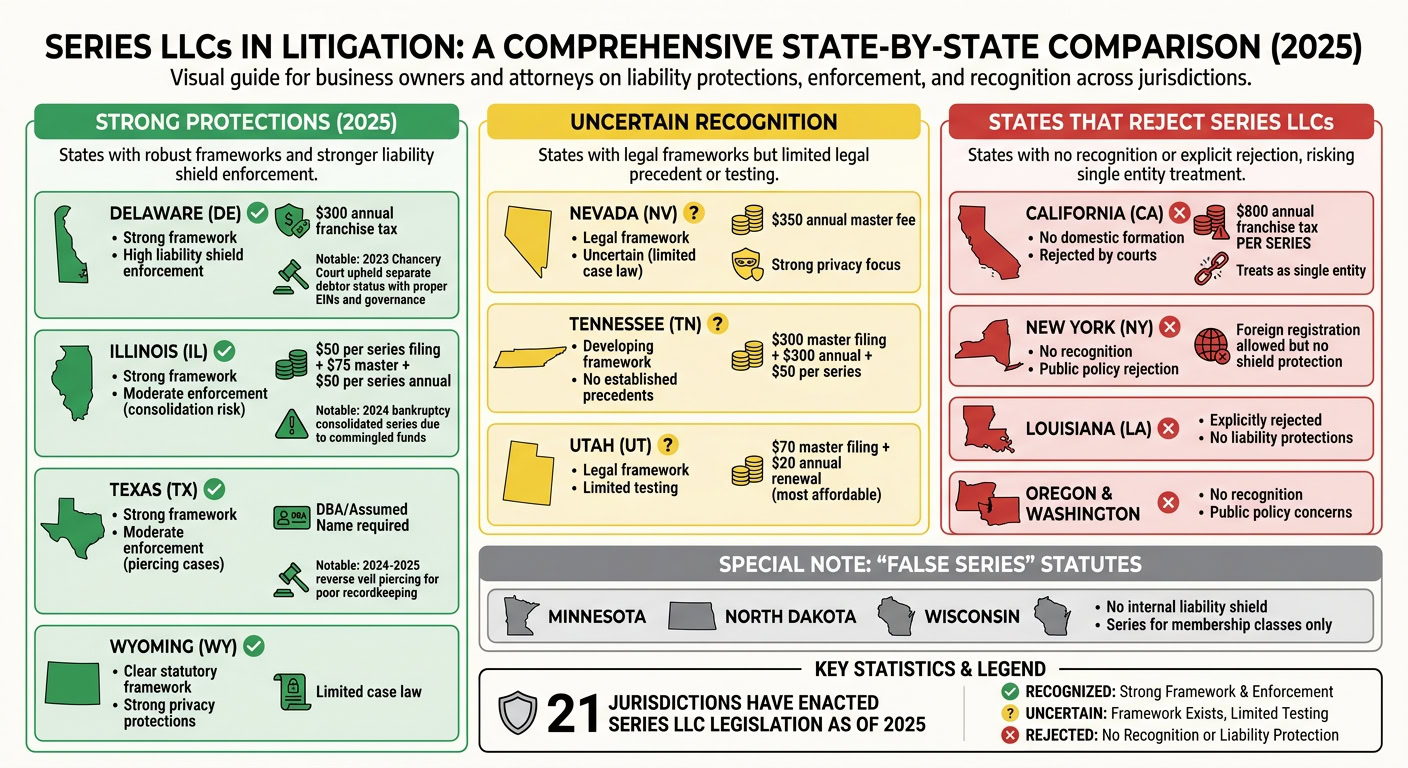
By 2025, 21 jurisdictions in the U.S. have enacted specific Series LLC legislation. However, how courts handle these entities can vary widely depending on the state of formation and operation. These differences can impact the legal protection of your assets, making it essential to understand how Series LLC liability shields vary by state in court.
States with Clear Laws and Strong Protections
Delaware is the trailblazer for Series LLCs, with a well-established legal framework. Delaware courts, particularly the Court of Chancery, have upheld the internal liability shield when series maintain separate EINs, distinct records, and independent governance. For instance, a Delaware court recognized a specific series as a separate debtor entity under these conditions. The state charges a flat $400 annual franchise tax for the master LLC, no matter how many series are created beneath it.
Illinois also provides strong statutory protections but comes with more administrative requirements. Each series must file a Certificate of Designation, costing $50, alongside a $75 annual report fee for the master LLC and $50 for each series. However, Illinois courts have shown a willingness to consolidate series in bankruptcy cases if evidence of commingled funds or shared accounts exists. A 2024 bankruptcy case highlighted this risk when all series within an Illinois Series LLC were treated as a single entity.
Texas offers flexibility with two types of series: “protected” series, established through operating agreements without state filings, and “registered” series, which require formal filings with the Secretary of State. However, between 2024 and 2025, Texas courts pierced the liability shield in cases where businesses failed to maintain proper administrative formalities, allowing creditors to access assets across series.
Wyoming provides a clear statutory framework and strong privacy protections for Series LLCs. While its laws are favorable, Wyoming lacks the extensive case law seen in Delaware or Illinois, leaving some questions about how courts will handle complex disputes.
Not all states, however, provide such straightforward protections.
States with Limited or Uncertain Recognition
Nevada allows Series LLCs and charges a $350 annual fee for the master LLC. While the state offers strong privacy protections, limited case law creates uncertainty in complex litigation. Additionally, Nevada does not require separate filing fees for individual series, which simplifies administration but could lead to challenges in proving separation in court.
Tennessee is a newer player in the Series LLC space, with a $300 filing fee for the master LLC and annual report fees of $300 for the master and $50 per series. Because its framework is still developing, Tennessee courts have yet to establish a clear precedent for handling Series LLC disputes.
Utah stands out for its affordability, with a $70 formation fee and a $20 annual renewal fee. While its statutes support Series LLCs, the lack of significant court testing leaves some uncertainty about how Utah courts will handle complex cases.
On the other hand, certain states outright reject the Series LLC model.
States That Reject Series LLCs
California, New York, Oregon, and Washington do not recognize the internal liability shield of Series LLCs due to public policy concerns. While these states allow Series LLCs to register as foreign entities for business purposes, they provide no guarantees that courts will respect the separation between series. For example, California imposes an $800 annual franchise tax on each individual series, even though it does not permit domestic Series LLC formation.
In these states, courts are likely to treat the entire Series LLC as a single entity, collapsing the separation between series. For businesses operating in these jurisdictions, forming traditional LLCs for each asset may offer more predictable liability protection than relying on a Series LLC structure.
State-by-State Comparison Table
The table below provides an overview of how different states address Series LLC litigation risks, liability protections, and compliance requirements. Use this as a guide to better understand the varying legal landscapes.
| State | Recognition Status | Liability Shield Enforcement | Notable Court Decisions | Foreign Qualification | Compliance Requirements |
|---|---|---|---|---|---|
| Delaware | Strong legal framework | High – upheld when formalities are maintained | In 2023, the Chancery Court recognized an individual series as a separate debtor with distinct EINs, separate books, and independent governance | Widely recognized | $400 annual franchise tax; no separate series filings required |
| Illinois | Strong legal framework | Moderate – risk of consolidation | In 2024, a Bankruptcy Court consolidated all series due to commingled funds and shared accounts | Recognized but may involve higher filing costs | $50 per series filing; $75 master annual fee plus $50 per series annual fee |
| Texas | Strong legal framework | Moderate – recent reverse veil piercing cases | Courts in 2024–2025 granted reverse veil piercing due to poor recordkeeping | Recognized | DBA/Assumed Name required; no separate series filings |
| Nevada | Legal framework | Uncertain – limited case law | No major precedents | Recognized with a privacy focus | $350 annual master fee; no separate series filings |
| Tennessee | Developing framework | Uncertain – new statute with no established precedents | No established precedents | Recognized | $300 master filing fee; $300 annual report fee plus $50 per series annual fee |
| Utah | Legal framework | Uncertain – limited testing | No major precedents | Recognized | $70 master filing fee; $20 annual renewal fee |
| California | No domestic formation allowed | Rejected – courts treat the structure as a single entity | Courts reject the internal liability shield | Foreign series taxed $800 each | $800 annual franchise tax per series |
| New York | No recognition | Rejected – public policy concerns | Courts are likely to collapse the structure into a single entity | Foreign registration allowed but no shield protection | Standard foreign LLC requirements |
| Louisiana | No recognition | Explicitly rejected | Courts have explicitly rejected liability protections | Not recognized | N/A |
| Minnesota | “False series” statute | No internal shield | Statute provides no liability protection | Not applicable | Series for membership classes only |
| North Dakota | “False series” statute | No internal shield | Statute provides no liability protection | Not applicable | Series for membership classes only |
| Wisconsin | “False series” statute | No internal shield | Statute provides no liability protection | Not applicable | Series for membership classes only |
Note: States like Minnesota, North Dakota, and Wisconsin only allow “series” provisions for membership classification, offering no internal liability shield.
Key takeaway: Liability protections for a Series LLC often depend on the state of formation and may not extend to other jurisdictions. It’s essential to understand these variations to protect your business effectively and ensure compliance with state-specific requirements.
How to Protect Your Series LLC from Litigation Risks
The strength of a Series LLC often hinges on how well you maintain the independence of each series. Courts have repeatedly shown that if you treat your series as a single entity, you risk losing the liability protection you set up.
Keep Each Series Completely Separate
Mixing assets or records between series is the top reason courts invalidate liability protections. Each series must have its own bank account, financial records, and legal documents that clearly identify it (e.g., “Master LLC, Series A”). These separate records are the foundation of your liability shield.
Obtaining distinct Employer Identification Numbers (EINs) for each series is another critical step. For example, in 2023, the Delaware Chancery Court upheld the separate legal status of a series because it maintained its own EIN, separate accounting books, and independent governance records. Without these formalities, even the strongest state protections may fail.
“The lesson: unless every series operates like its own company – with its own records, tax filings, and governance – courts will collapse them together.”
- Brian T. Bradley, Esq., Asset Protection Attorney
Avoid transferring funds between series unless you document the transactions with proper loan agreements. To further demonstrate independence, consider using separate business locations or distinct digital filing systems for each series.
Once you’ve ensured functional independence for each series, double-check that you’re meeting your state’s specific regulatory requirements.
Follow Your State’s Specific Requirements
Each state has its own compliance rules for Series LLCs, and even a small oversight can jeopardize your liability protection. Your master operating agreement must explicitly allow for the creation of series and clearly define the rights, responsibilities, and assets of each one, adhering to your state’s laws.
If your Series LLC operates in multiple states, the risks increase. For instance, if a Delaware Series LLC owns property in states like California or New York – where the series structure isn’t recognized – courts may disregard the liability shield and treat the LLC as a single entity. Regular compliance audits can help ensure each series meets its state-specific requirements and maintains separate records.
Given the complexities of these requirements, professional assistance is often a smart choice.
Use Professional Services for Compliance Management
“A single mistake can destroy the liability protection you’re aiming for.”
Managing compliance for a Series LLC can be complicated, and professional services can help you avoid costly errors. In recent cases in Texas and Montana, courts allowed creditors to access the assets of multiple series because the owners failed to maintain distinct records and governance for each series.
Platforms like BusinessAnywhere offer tools to simplify Series LLC management. They handle key compliance tasks, such as registered agent services for the master LLC (which often acts as the agent for all series), state-specific annual filings, and compliance reminders to prevent missed deadlines. Services like business registration, registered agent service (free for the first year when bundled), and existing company maintenance start at $147 per year, providing a cost-effective way to stay on top of compliance.
The platform also offers a document management dashboard to keep the separate records courts require, along with virtual mailbox services starting at $20 per month (billed annually) to ensure each series has a professional U.S. address for receiving mail. For notarization needs, remote online notary services at $37 per document make staying compliant even easier – all managed remotely through a single interface.
With limited case law surrounding Series LLCs, professional compliance management isn’t just helpful – it’s a critical safeguard for your business structure.
Conclusion
Series LLCs offer robust liability protection and potential cost efficiency – but only if you fully understand how your state’s courts approach them. Currently, about 21 states and Washington, D.C., permit Series LLCs, while states like California, New York, Oregon, and Washington do not. In these states, the entire Series LLC structure may be treated as a single entity for liability purposes. This patchwork of state recognition means your Series LLC’s legal standing depends heavily on where you form and operate it.
The internal liability shield of a Series LLC hinges on strict compliance with state-specific rules. Courts have disregarded the liability protections when owners failed to maintain separate bank accounts, records, or governance for each series. Even in Delaware, a popular state for forming Series LLCs, maintaining clear boundaries between series is critical.
Federal bankruptcy law adds another layer of complexity. Judges evaluate Series LLCs on a case-by-case basis, deciding whether to treat individual series as separate debtors. This makes meticulous compliance even more essential.
Managing a Series LLC requires careful attention to detail, from drafting precise operating agreements to correctly titling assets. Professional compliance tools can make this process manageable. Platforms like BusinessAnywhere offer solutions to reduce administrative stress. They provide registered agent services, handle state-specific filings, and send compliance alerts starting at $147 per year. Their document management tools and virtual mailbox services (starting at $20 per month, billed annually) help you maintain the separate records and professional addresses that courts require.
In the end, the effectiveness of a Series LLC depends on treating each series as an independent entity and staying compliant with your state’s requirements. With limited case law and evolving interpretations, there’s little room for error. Professional compliance support isn’t just helpful – it’s essential to maintaining the liability protections that make Series LLCs so appealing. Keeping detailed, separate records for each series is the cornerstone of a legally sound Series LLC structure.
FAQs
Do I need a separate EIN for each series?
Each series within a Series LLC usually needs its own EIN. This is because, under state law, each series can function as an independent entity for legal and tax purposes, depending on its structure and recognition.
Will my series liability shield hold up in another state?
The liability protection offered by a Series LLC might not hold up in states that don’t acknowledge or enforce the separation of series within the LLC. Some courts are still uncertain about how effective these protections are. That’s why it’s crucial to familiarize yourself with the laws in the state where your business operates or where you might face legal challenges.
What paperwork mistakes most often destroy the shield?
Improper handling of paperwork can jeopardize the liability protections of a Series LLC. Common missteps include failing to segregate assets properly, mixing assets between series, and overlooking the need for detailed, state-specific clauses in the operating agreement. These clauses should address key aspects like governance, formation, and dissolution to ensure each series remains distinct and protected.