


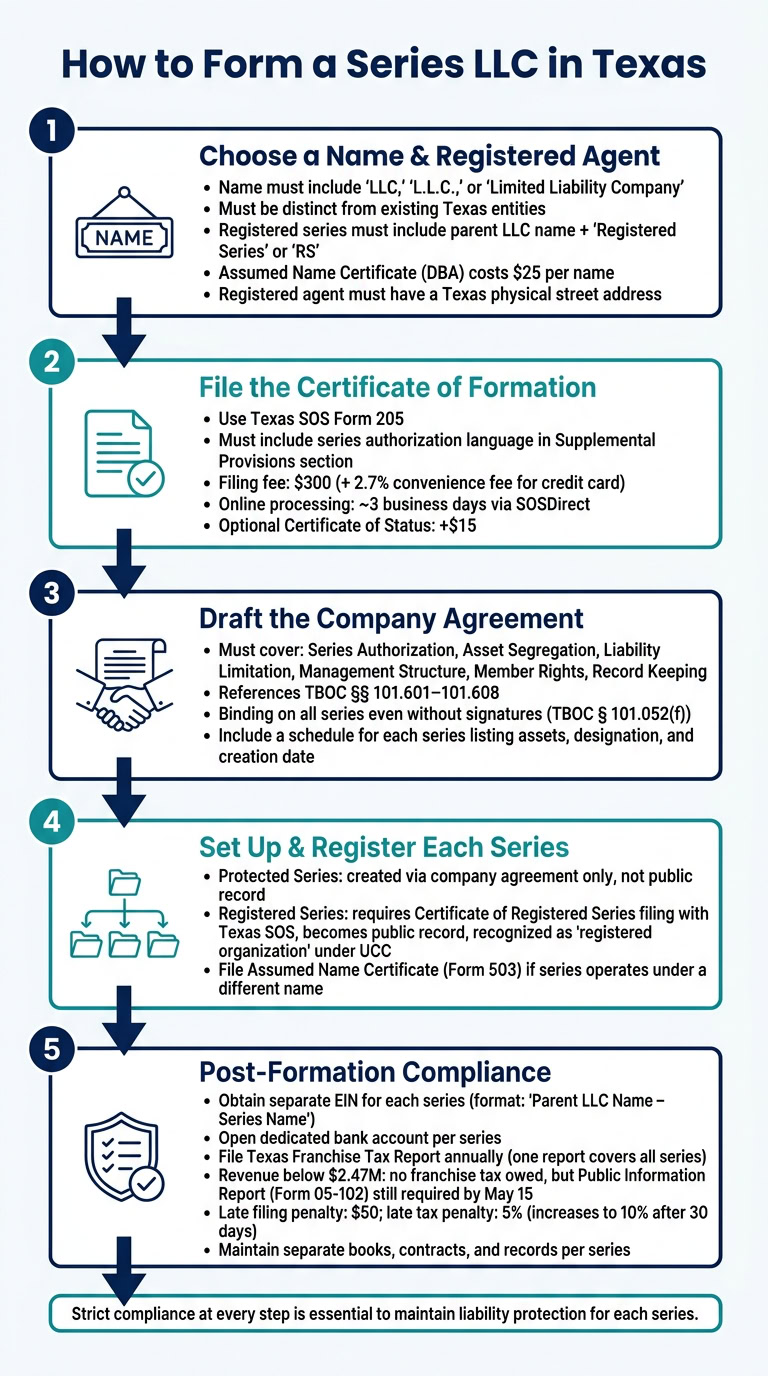
A Texas Series LLC is a cost-effective way to manage multiple businesses or assets under one legal structure. This setup allows you to create separate "series" within a parent LLC, each with its own assets, liabilities, and operations. Here’s how to get started:
- Choose a Name and Registered Agent: Ensure your LLC name meets Texas requirements and appoint a registered agent to handle legal documents.
- File the Certificate of Formation: Submit Form 205 with specific language authorizing the series structure. The filing fee is $300.
- Draft a Company Agreement: Outline the rules, liabilities, and management structure for the parent LLC and its series.
- Register Each Series: Use the company agreement for protected series or file a Certificate of Registered Series for public recognition.
- Maintain Compliance: Keep separate financial records, file annual reports, and meet Texas tax obligations.
This structure simplifies administration and reduces costs, but maintaining strict compliance is essential to protect liability shields.
Step 1: Choose a Name and Registered Agent
Naming Your Series LLC
The name of your Series LLC is one of the first details reviewed by the Texas Secretary of State, so it needs to meet specific state requirements. The parent LLC’s name must include "Limited Liability Company", "Limited Company", or an abbreviation like "LLC" or "L.L.C.". On top of that, your name must be distinct from any other business entity already registered in Texas.
To avoid any issues, use the Texas Comptroller of Public Accounts entity name search tool to confirm the name you want is available. While you’re at it, you might want to check if the corresponding domain name is also free.
Keep in mind that certain words are either prohibited or require extra steps. For example, names suggesting a government affiliation, referencing veterans’ organizations, or containing the word "lottery" are not allowed. Words like "Bank", "University", or "Attorney" may require additional documentation or proof of licensure.
If you’re forming a registered series, the naming rules are slightly different. Each registered series must include the parent LLC’s full name along with "Registered Series" or an abbreviation like "RS" or "R.S.". Since these formal names can get lengthy, many business owners file an Assumed Name Certificate (Form 503) to adopt a shorter, more marketable name for each series. Filing this certificate costs $25 per name.
Once your name is secured, you’re ready to move on to designating a registered agent.
Appointing a Registered Agent
Every LLC in Texas, including Series LLCs, is required to have a registered agent. This is the person or entity responsible for receiving legal documents, such as lawsuits or official state notices, on behalf of your business during regular business hours.
For a Series LLC, the registered agent designated for the parent LLC automatically serves all the series within it. Texas Business Organizations Code Section 5.302 clarifies this:
"The registered agent designated and maintained by a domestic limited liability company… is an agent of each series of the company or entity for the purpose of service of process, notice, or demand required or permitted by law to be served on a particular series."
The registered agent must meet a few criteria: they must be a Texas resident or a business authorized to operate in the state, and they need to have a physical street address in Texas (P.O. Boxes don’t qualify). Additionally, the agent must formally accept their role by signing Form 401-A, which you keep in your records rather than file with the state.
Failing to maintain a registered agent can lead to fines or even the automatic dissolution of your LLC, which could jeopardize your liability protections. To avoid such risks, many business owners opt for the best registered agent service for their needs. For example, companies like BusinessAnywhere provide these services starting at $147 per year, ensuring someone is always available to handle important documents on your behalf, no matter where you operate from.
Step 2: File the Certificate of Formation
Once you’ve picked a name and chosen a registered agent, the next step is to file the Certificate of Formation with the Texas Secretary of State. This officially establishes your Series LLC.
Filing Requirements and Costs
To file for a Series LLC in Texas, you’ll use the standard Texas SOS Form 205, but there’s an important twist: you’ll need to include specific series authorization language in the "Supplemental Provisions and Attachments" section. Without this, your LLC won’t have the liability separation that makes a Series LLC so useful. Essentially, this omission would undermine the entire purpose of the Series LLC structure.
Texas Business Organizations Code § 101.602(a) explains what this language must include:
"The debts, liabilities, obligations, and expenses incurred, contracted for, or otherwise existing with respect to a particular series shall be enforceable against the assets of that series only, and shall not be enforceable against the assets of the limited liability company generally or any other series."
Your Certificate of Formation also needs to include several essential details:
- The name of your LLC
- The registered agent’s Texas street address
- The governing structure (whether it’s member-managed or manager-managed, along with contact details)
- A general purpose statement
- At least one organizer’s name, address, and signature
The filing fee for this process is $300, with an additional 2.7% convenience fee for credit card payments. If you want a Certificate of Status, that will cost an extra $15.
Filing Methods
You can submit your Certificate of Formation using one of four methods:
| Filing Method | Processing Time | Notes |
|---|---|---|
| Online (SOSDirect) | ~3 business days | Available 24/7; credit card payments incur a 2.7% fee |
| 5–7 business days | Send to P.O. Box 13697, Austin, TX 78711 | |
| In-Person | Varies | Visit 1019 Brazos, Austin, TX 78701 |
| Fax | Varies | Credit card payments accepted |
For most people, filing online via SOSDirect is the fastest and easiest option, with typical processing times of about 3 business days.
Before filing online, make sure you’ve prepared the series authorization language for the Supplemental Provisions section. The Texas Secretary of State emphasizes:
"The web form promulgated by the secretary of state is designed to meet minimum statutory filing requirements… This web form is not specifically designed to authorize the formation of the LLC as a series LLC."
If you need your LLC to officially start on a future date, you can set a delayed effective date – up to 90 days from the signing date. Keep in mind that once filed, all information in the Certificate of Formation becomes public record.
Step 3: Draft the Company Agreement
Once your Certificate of Formation is filed, the next step is drafting a company agreement. This document is essential for formalizing liability separation within your Series LLC. While the Certificate of Formation establishes the framework, the company agreement defines the internal rules and protections for each series.
"The operating agreement is important for a Texas series LLC because it creates the protection between the child series and parent LLC. The operating agreement outlines the liability limitations (asset protection) of the child series." – TRUiC Team
What to Include in the Company Agreement
To ensure the agreement is both functional and legally sound, it should address six key areas:
| Key Element | What It Does | Legal Reference |
|---|---|---|
| Series Authorization | Grants the LLC the ability to establish multiple series | TBOC § 101.601 |
| Asset Segregation | Requires each series to hold its assets separately | TBOC § 101.603 |
| Liability Limitation | Specifies that the debts of one series do not affect others | TBOC § 101.602 |
| Management Structure | Defines governance for the parent LLC and each series | TBOC § 101.608 |
| Member Rights | Outlines voting and distribution rights for each series | TBOC § 101.607 |
| Record Keeping | Requires separate books and records for each series | TBOC § 101.501 |
Additionally, include a schedule for each series that lists its assets, designation, creation date, and initial contributions. This helps demonstrate clear asset separation for legal and operational purposes.
It’s also important to clarify whether the parent LLC’s manager oversees all series or if each series has its own leadership. Structure voting rights and profit distributions so that members of a specific series only participate in decisions and profits related to that series.
Keeping the Agreement Legally Compliant
To ensure legal compliance, the company agreement must align with state laws and the liability language in your Certificate of Formation. Any inconsistencies could weaken the protections your Series LLC relies on. Texas Business Organizations Code § 101.052(f) emphasizes that the agreement is binding across all series, regardless of whether they have formally signed it:
"A company agreement is enforceable by or against the limited liability company, including a protected series or registered series of the company, regardless of whether the company, or the protected series or registered series of the company, has signed or otherwise expressly adopted the agreement."
Where the agreement lacks detail, Texas Business Organizations Code default rules will apply. However, these default rules may not always work in your favor, so drafting a thorough agreement is critical. The agreement should also allow for flexibility, enabling you to add new series later by amending the document and filing the necessary assumed name certificates (also known as filing a DBA in Texas).
sbb-itb-ba0a4be
Step 4: Set Up and Register Each Series
Once your company agreement is finalized, you can create individual series through the agreement itself. In Texas, there’s no need to file with the state unless you’re forming a registered series. To determine which structure fits your needs, consider the differences between protected and registered series below.
Protected Series vs. Registered Series
One of the perks of a Series LLC in Texas is the ability to create distinct series, which can save on costs and simplify administration. Texas allows for two types of series – protected and registered – each with specific rules regarding public records, financing, and naming.
| Feature | Protected Series | Registered Series |
|---|---|---|
| Creation Method | Company Agreement | Certificate of Registered Series (SOS Filing) |
| Public Record | No (unless a DBA is filed) | Yes |
| Naming Suffix | No specific requirement | Must include "Registered Series", "RS", or "R.S." |
| UCC Status | "Person" | "Registered Organization" |
| Liability Shield | Yes (if requirements met) | Yes (if requirements met) |
A protected series is created solely through your company agreement and does not appear in public records unless you file an assumed name certificate. On the other hand, forming a registered series requires submitting a Certificate of Registered Series to the Texas Secretary of State. Once filed, this certificate becomes a public record, and the series is officially recognized as a "registered organization" under the Uniform Commercial Code (UCC). This designation can simplify securing financing and perfecting security interests.
"The registered agent designated and maintained by a domestic limited liability company… is an agent of each series of the company." – Texas Business Organizations Code § 5.302(a)
Filing Assumed Name Certificates
If a series operates under a name different from the LLC’s, you’ll need to file an Assumed Name Certificate (SOS Form 503) with both the Secretary of State and the appropriate county clerk. This filing ensures the series maintains its distinct identity and liability shield.
When adding a new series, update your company agreement to include details like its assets, members, and objectives. If the series has a unique name, file the Assumed Name Certificate before moving forward. To further safeguard the liability shield, maintain separate bank accounts and EINs for each series.
Step 5: Post-Formation Compliance Tasks
Once your Series LLC is formed, the real work begins. To keep your Series LLC in good standing in Texas, you’ll need to stay on top of several ongoing administrative responsibilities. These tasks apply to both the parent LLC and each individual series.
Get EINs and Open Bank Accounts
To maintain the liability protection for each series, proper financial setup is crucial. Each series must have its own EIN from the IRS. Without a unique EIN, you won’t be able to open a dedicated bank account, which could jeopardize the liability shield.
When applying for EINs, use a clear naming format like "[Parent LLC Name] – [Series Name]" (e.g., "Lone Star Holdings LLC – Series A") to ensure the IRS can easily distinguish between entities. After obtaining the EIN, open a separate bank account for each series and use it exclusively for that series’ transactions. Mixing funds between series or with the parent LLC could compromise the liability protection and expose all assets to potential claims.
If you’re unsure how to obtain EINs, BusinessAnywhere offers an EIN application service for $97 per filing. They’ll handle everything from preparation to submission and follow-up on your behalf.
File Texas Franchise Tax Reports
Once your financial accounts are set up, you’ll need to comply with Texas tax requirements. Texas treats the entire Series LLC as one taxable entity for franchise tax purposes. This means the parent LLC files a single Franchise Tax Report that covers all series, rather than filing separate reports for each one.
Here’s what you need to know:
- Revenue Threshold: If your combined annual revenue across all series is below $2.47 million (as of 2025), you won’t owe franchise tax. However, you’re still required to file a Public Information Report (Form 05-102) every year by May 15.
- Penalties: Missing the May 15 deadline for the Public Information Report results in a $50 penalty, even if no tax is due. If you owe franchise tax and pay late, you’ll face an initial 5% penalty, which increases to 10% if the payment is more than 30 days overdue.
| Revenue Level | Franchise Tax Report | Public Information Report | Due Date |
|---|---|---|---|
| Below $2.47M | Not required | Required (Form 05-102) | May 15 |
| Above $2.47M | Required (EZ or Long Form) | Required (Form 05-102) | May 15 |
Since all series revenue is combined for this filing, keeping detailed financial records for each series throughout the year will make the process much easier.
Keep Records Separate for Each Series
Beyond separate bank accounts, it’s essential to maintain distinct records for each series to uphold the liability shield. Each series should have its own books, contracts, and operational documents. For example, if Series B owns a property in Austin, the lease and insurance policy must name "Lone Star Holdings LLC – Series B", not just "Lone Star Holdings LLC".
For shared expenses, such as office space or software subscriptions used by multiple series, document a clear and consistent allocation method. Arbitrary or undocumented splits could weaken your liability protection in court. Treat each series as if it were an independent business – because legally, it is.
Conclusion
Every step in forming a Series LLC in Texas plays a role in safeguarding its structure and liability protection. It’s not just about filing paperwork – getting the name right, appointing a registered agent, drafting a precise Certificate of Formation, creating a solid company agreement, and properly establishing each series are all critical. Once formed, maintaining separate EINs, dedicated bank accounts, distinct records, and staying on top of annual filings ensures that liability protection remains intact. Even small mistakes can jeopardize this, so attention to detail is key.
When done right, the Series LLC structure provides an efficient way to manage multiple assets or businesses under one umbrella, with clear legal separation between them. Many business owners opt for professional services to navigate the complexities. For instance, BusinessAnywhere offers tools to simplify the process, including registered agent services (starting at $147/year), EIN applications ($97 per filing), annual report filings, and compliance alerts – all accessible through a remote online dashboard.
A Texas Series LLC can be a scalable and cost-effective solution, but the key is strict compliance and regular reviews. Leveraging expert assistance can help ensure everything stays on track, giving you peace of mind while managing your ventures.
FAQs
Do I need a separate EIN for each series in a Texas Series LLC?
In a Texas Series LLC, you don’t need to obtain a separate EIN for each series. Typically, a single EIN is used for the parent Series LLC. While it’s possible to get additional EINs for individual series, it’s entirely optional.
When should I choose a protected series vs. a registered series in Texas?
In Texas, a protected series is ideal if you’re looking for internal asset segregation and liability protection without needing formal state registration. On the other hand, a registered series provides a distinct legal entity with public registration, enabling it to independently enter contracts, sue, or be sued. While registered series offer greater formal recognition and enforceability, protected series emphasize internal liability separation.
What mistakes can break the liability protection between series?
Failing to follow certain rules can jeopardize the liability protection in a Series LLC. Key missteps include not keeping separate accounting records for each series, leaving out a liability limitation statement in the operating agreement, and failing to include a notice of limitations in the certificate of formation. Additionally, issues like not complying with naming requirements, filing incorrectly, or having poorly written formation documents can result in courts "piercing" the liability shield, leaving members exposed to risks.